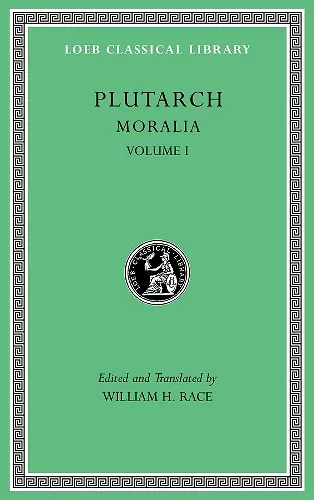
Moralia, Volume I
The Education of Children. How the Young Man Should Study Poetry. On Listening to Lectures. How to Tell a Flatterer from a Friend. How a Man May Become Aware of His Progress in Virtue
Plutarch author William H Race editor
Format:Hardback
Publisher:Harvard University Press
Publishing:31st Jul '26
£24.95
This title is due to be published on 31st July, and will be despatched as soon as possible.
Eclectic essays on ethics, education, and much else besides.
Plutarch (Plutarchus), ca. AD 45–120, was born at Chaeronea in Boeotia, in central Greece. He is renowned for his forty-six Parallel Lives, biographies planned to be ethical examples in pairs (in each pair, one Greek figure and one comparable Roman), though the last four lives are single. But he was also a teacher of philosophy in Rome, a priest at Delphi, and an engaging essayist with an urbane and judicious style whose many other extant works, some seventy in number and known collectively as Moralia or Moral Essays, are important sources for classical philosophy, ethics, and religion. Whether advising about marriage and education, discussing prophecy, divine providence, and life after death, setting forth rules for politicians, or commenting on personal virtues and vices, the Moralia reveal not only Plutarch’s own thinking but also the world in which he lived.
The Loeb Classical Library edition of the Moralia is in sixteen volumes, volume XIII having two parts. Volume XVI comprises an analytical index that provides access to the great riches to be found within the collection. In the present volume are five essays: The Education of Children, How the Young Man Should Study Poetry, On Listening to Lectures, How to Tell a Flatterer from a Friend, and How a Man May Become Aware of His Progress in Virtue.
This edition, which replaces the original by Frank Cole Babbitt (1927), offers text, translation, and annotation that are fully current with modern scholarship.
ISBN: 9780674997790
Dimensions: unknown
Weight: unknown
544 pages