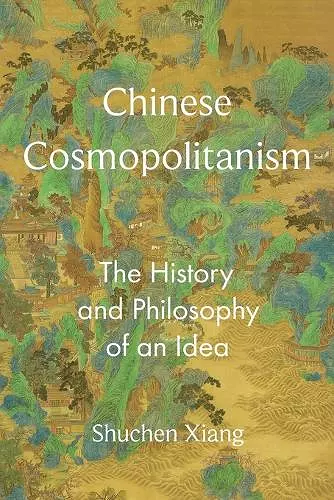
Chinese Cosmopolitanism
The History and Philosophy of an Idea
Format:Paperback
Publisher:Princeton University Press
Published:24th Mar '26
Should be back in stock very soon
This paperback is available in another edition too:
- Hardback£30.00(9780691242729)
A provocative defense of a forgotten Chinese approach to identity and difference
Historically, the Western encounter with difference has been catastrophic: the extermination and displacement of aboriginal populations, the transatlantic slave trade, and colonialism. China, however, took a different historical path. In Chinese Cosmopolitanism, Shuchen Xiang argues that the Chinese cultural tradition was, from its formative beginnings and throughout its imperial history, a cosmopolitan melting pot that synthesized the different cultures that came into its orbit. Unlike the West, which cast its collisions with different cultures in Manichean terms of the ontologically irreconcilable difference between civilization and barbarism, China was a dynamic identity created out of difference. The reasons for this, Xiang argues, are philosophical: Chinese philosophy has the conceptual resources for providing alternative ways to understand pluralism.
Xiang explains that “Chinese” identity is not what the West understands as a racial identity; it is not a group of people related by common descent or heredity but rather a hybrid of coalescing cultures. To use the Western discourse of race to frame the Chinese view of non-Chinese, she argues, is a category error. Xiang shows that China was both internally cosmopolitan, embracing distinct peoples into a common identity, and externally cosmopolitan, having knowledge of faraway lands without an ideological need to subjugate them. Contrasting the Chinese understanding of efficacy—described as “harmony”—with the Western understanding of order, she argues that the Chinese sought to gain influence over others by having them spontaneously accept the virtue of one’s position. These ideas from Chinese philosophy, she contends, offer a new way to understand today’s multipolar world and can make a valuable contribution to contemporary discussions in the critical philosophy of race.
"Honorable Mention for the Asia and Asian America Section Book Award, American Sociological Association"
"Eye-opening. . . . [Xiang] offers a deeply informed perspective to confront our own often half-understood or misunderstood beliefs about ourselves and others."---Alex Lo, South China Morning Post
"Chinese Cosmopolitanism is compelling in its stringent critique of Western worldviews rooted in racism, colonialism, and Eurocentrism. . . . [A]n illuminating and inspirational book."---Ban Wang, Chinese Studies International
"Provacative. . . . [T]here is still no diminishing the value of what Shuchen Xiang has achieved through ChineseCosmopolitanism. Given its longstanding knowledge of foreign lands and peoples, many of which were ripe for exploitation, and its recognizable capacity over the ages for imposing its will especially in far-flung places beyond Inner and East Asia militarily whenever it could have elected to, exactly why China chose not to do so is a conundrum. Xiang has isolated and explicated in depth one reason for Chinese restraint that may prove more compelling, determinative, and influential on our understanding of this noninterventionist attitude than any other."---Don J. Wyatt, Journal of Chinese History
"Compelling. . . . Chinese Cosmopolitanism is an illuminating and inspirational book. With vigor and eloquence, Xiang asserts Chinese cosmopolitan visions in sharp contrast with Western worldviews."---Ban Wang, Chinese Studies International
"A captivating exploration of humanity’s engagement with diversity. . . . Xiang’s book encourages the study of diverse models of human understanding, and points to the potential of nurturing genuine interpersonal solidarity and cooperation, transcending the limitations inherent in essentialist interpretations of 'races' and 'cultures.' Its significance transcends regional boundaries, appealing to a worldwide audience interested in uncovering the philosophical and ideological origins of biases deeply entrenched within dominant political systems across the globe."---Jana S. Rošker, Journal of Chinese Philosophy
"This provocative book raises important questions and deserves to be read and discussed."---Nicolai Volland, Migrating Minds
"Chinese Cosmopolitanism is an extraordinary contribution to critical philosophy of race and provides a unique avenue of antiracism that addresses issues of white ignorance within comparative philosophy and Sinology. . . . [A] must-read."---Christopher Rahlwes, Philosophy and Global Affairs
"Shuchen Xiang’s Chinese Cosmopolitanism is a wonderful book. Deeply researched and deeply provocative, Xiang argues that there is an inherent racism in the West’s academic views of itself and that of Chinese philosophy. . . . Xiang’s book is important for the social sciences and the humanities. Xiang has taken a courageous stand by pointing out the diversity of philosophical ideas across the globe."---David C. Kang, Journal of Social and Political Philosophy
"The characteristics of Chinese civilisation and thought have been widely studied. However, comparatively little research has focused on what distinguishes the Chinese cosmopolitan mentalité from the worldview of other civilisations, especially the Western ideal derived from its Graeco-Christian tradition. This is largely because positioning China’s place in world history and identifying Chinese characteristics require comparative perspectives in history and philosophy, and it is almost impossible to master both. The publication of Chinese Cosmopolitanism . . . which efficaciously accomplishes such a challenging intellectual task, is a great boon not just to global Sinology but also to comparative philosophy, comparative and historical sociology and other related fields."---Byung-Ho Lee, Journal of Social and Political Philosophy
ISBN: 9780691242736
Dimensions: unknown
Weight: unknown
272 pages