Controlling Contagion
Epidemics and Institutions from the Black Death to Covid
Format:Hardback
Publisher:Princeton University Press
Published:18th Mar '25
Should be back in stock very soon
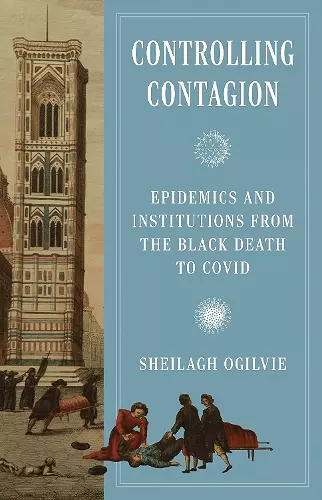
How human institutions—markets, states, communities, religions, guilds and families—have helped both to control and to exacerbate epidemics throughout history.
How do societies tackle epidemic disease? In Controlling Contagion, Sheilagh Ogilvie answers this question by exploring seven centuries of pandemics, from the Black Death to Covid-19. For most of history, infectious diseases have killed many more people than famine or war, and in 2019 they still caused one death in four. Today, we deal with epidemics more successfully than our ancestors managed plague, smallpox, cholera or influenza. But we use many of the same approaches. Long before scientific medicine, human societies coordinated and innovated in response to biological shocks—sometimes well, sometimes badly.
Ogilvie uses historical epidemics to analyse how human societies deal with “externalities”—situations where my action creates costs or benefits for others beyond those that I myself incur. Social institutions—markets, states, communities, religions, guilds, and families—help us manage the negative externalities of contagion and the positive externalities of social distancing, sanitation, and immunization. Ogilvie shows how each institution enables us to coordinate, innovate and inspire each other to limit contagion. But each institution also has weaknesses that can make things worse. Markets shut down voluntarily during every epidemic in history—but they also brought people together, spreading contagion. States mandated quarantines, sanitation, and immunization—but they also waged war and censored information, exacerbating epidemics. Religions admonished us to avoid infecting our neighbours—but they also preached against science and medical innovations. What decided the outcome, Ogilvie argues, was a temperate state, an adaptable market, and a strong civil society where a diversity of institutions played to their own strengths and checked each other’s flaws.
"A Choice Outstanding Academic Title of the Year"
"Ogilvie’s book ranges from the 14th century—the era of the Black Death—to the 21st. . . . [Her] wide-ranging survey throws up some telling points. . . . [And] exposes some cherished fallacies."---Virginia Berridge, BBC History Magazine
"An important book that opens analysis of epidemics across time and space within a new framework of institutional history."---Samuel Cohn, Political Quarterly
"An ambitious study. . . . It is impossible to offer more than a glimpse of Ogilvie’s compass and erudition."---Nicholas Brown, Australian Book Review
"This is the first scholarly work to connect [epidemics] to institutions, markets and how states perform over many centuries. . . . Ogilvie unpacks what history and cross-country comparisons tell us about the ability of societies to respond to epidemics. . . . If there is one lesson from this most impressive book, it is that preparation for and effective responses to epidemics are of critical importance."---R. Quentin Grafton, Economic Record
"This is the book I would have liked to read in March 2020. . . . Ogilvie’s essay is rich and brimming with ideas. . . . For its breadth, documentation, and depth, Sheilagh Ogilvie’s Controlling Contagion is a work you cannot open without learning something. The author deserves her readers’ full gratitude."---Alberto Mingardi, Curious Task
"An impressive study."---David Lorimer, Paradigm Explorer
"Sheilagh Ogilvie haswritten another big and important book. It explores a new theme for her: how do societies respond to and tackle epidemics. . . .Controlling Contagion is a heroic work of ingestion that has no obvious equivalent in the literature."---Patrick Wallis, Economic History Review
"Sheilagh Ogilvie has written a definitive book on how people use institutions to respond to infectious diseases. . . . Her argument, theoretical framework, even-handed writing, myriad examples, and organization all make for an incredible resource. Scholars, laymen, and policy makers alike who are interested in public health and epidemics and in the economics and institutions of epidemiology should read Controlling Contagion."---Byron B. Carson III, The Review of Austrian Economics
"A large-scale, timely assessment of human society’s responses to epidemics."---George Dehner, American Historical Review
"This book is groundbreaking in the sociological aspects of epidemics. . . . Essential." * Choice *
"Controlling Contagion provides a nuanced and detailed history of the role six institutions played in the dispersion of contagious disease and will be of interest to scholars studying the economic history of both institutions and epidemics."---Martin Saavedra, The Journal of Economic History
"Accessible and timely. . . . Controlling Contagion is an ambitious work, advancing knowledge by assembling a vast body of evidence"---Vellore Arthi, Journal of Economic Literature
ISBN: 9780691255569
Dimensions: unknown
Weight: 1134g
544 pages