Magical Realism in Palestinian Literature and Folk Tales
Reading the Distorted Spaces of the Nakba
Sanabel Abdel Abdel Rahman author
Format:Hardback
Publisher:Bloomsbury Publishing PLC
Publishing:18th Feb '27
£85.00
This title is due to be published on 18th February, and will be despatched as soon as possible.
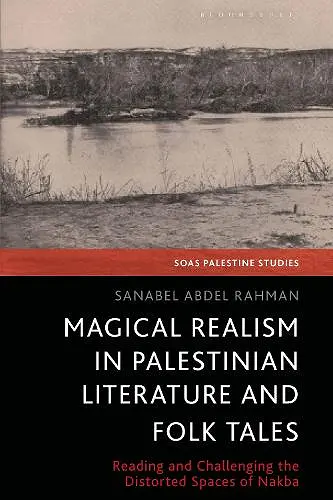
This book investigates the manifestations and functions of magical realism in Palestinian literature, as a tool that reflects and challenges the ongoing ramifications of the Nakba.
This book investigates the manifestations and functions of magical realism in STUDIES Palestinian literature, and folktales, especially in reflecting and challenging the ongoing ramifications of the Nakba.
Since the 1948 Nakba Palestinians have learned to live in two spaces simultaneously: the physical space of their lived reality and one of collective imaginary in which Palestine before the Nakba, and after liberation, exists. Here, Sanabel Abdel Rahman argues that magical realism, as a narrative literary mode, is used to reflect and challenge the distorted spaces of Palestinian existence.
The book analyzes mainly three works of literature: Saraya Bint al-Ghul: Khurafiyya (Saraya, the Ogre’s Daughter: A Palestinian Fairy Tale), Bab al-Shams (Gate of the Sun), and al-T.alabiyya C345 (Order C345) while also consulting the folktales from Qul ya T.ayr (Speak Bird, Speak Again). Through these texts (and others) magical-realist figures like ghosts, ogresses, cyborgs, and eco-surrealist creatures that revive Palestinian resilience and (re)connection to the land are investigated within the context of distorted spaces. Magical-realist tropes like dreams that reflect the nightmarish character of the current Palestinian reality, as well as dreams of liberation and future returns, are analyzed alongside genres such as surrealism and science fiction, while highlighting Palestinian agency and unity.
This study is the first of its kind to interrogate magical-realist and folkloric modes in the context of Palestinian literature in order to examine the distorted realities of the Palestinian experience since the Nakba. Drawing on Arabic language works of fiction, the book offers a unique approach to examining contemporary Arabic literary spaces and how these reflect and challenge lived realities.
This book makes a rigorous and timely intervention in Palestinian and Middle Eastern literary studies by reframing magical realism as a critical mode through which distorted space, memory, and futurity are negotiated under settler colonialism. Conceptually ambitious and grounded in Arabic literary and folkloric traditions, it will be essential reading for scholars of Palestinian, Middle Eastern and Mediterranean, and postcolonial literature. -- Bahriye Kemal, Associate Professor Postcolonial and Contemporary Literature, University of Kent/University College Cork
This book is an innovative academic contribution that impresses the reader with Dr. Sanabel Abdel Rahman’s brilliant invocation of Palestinian folklore and the realms of the supernatural and myth. She masterfully connects magical realism with the memory of place and the profound bond between the land and its people, demonstrating how literary creativity transforms into a robust tool for crystallizing Palestinian identity and an act of resistance that opens horizons toward liberation and return. * Amer Al-Qobbaj, Professor, An-Najah National University, Palestine *
This book is an innovative academic contribution that impresses the reader with Dr. Sanabel Abdel Rahman’s brilliant invocation of Palestinian folklore and the realms of the supernatural and myth. She masterfully connects magical realism with the memory of place and the profound bond between the land and its people, demonstrating how literary creativity transforms into a robust tool for crystallizing Palestinian identity and an act of resistance that opens horizons toward liberation and return. * Zahi Zalloua, Professor, Whitman College, USA *
ISBN: 9780755654819
Dimensions: unknown
Weight: unknown
240 pages