Israel's Occupation of the West Bank
Indirect Governance, Settlers, and Violence
Format:Hardback
Publisher:Bloomsbury Publishing PLC
Publishing:18th Feb '27
£85.00
This title is due to be published on 18th February, and will be despatched as soon as possible.
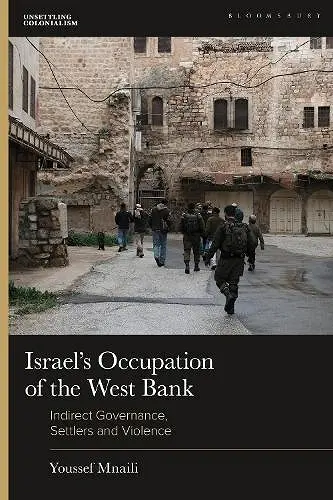
Explores how Israel's occupation of the West Bank has created a dependency on settlers, severely constraining Israeli politics in lasting and fundamental ways.
The Occupied Palestinian West Bank is central to the Israeli colonial project. It serves as a significant example of occupation. Yet little is understood about how Israeli rule over this area operates. Drawing on extensive fieldwork in Israel and Palestine, including interviews with state officials, settlers and military personnel, this book examines the evolution of Israeli rule over the West Bank since 1967. The book situates this post-1967 machinery within the longer history of the Zionist settler-colonial project, revealing that contemporary state-settler dynamics reproduce a division of labour with roots that predate 1948. In the book, Youssef Mnaili argues that Israeli governments have increasingly relied on Jewish settlers, approximately 700,000 civilians established in the occupied territories to perform key security and administrative roles. This reliance allows the state to distance itself from controversial practices such as surveillance and violence. Rather than representing a fundamental rupture, the disagreements between state and settlers reflect a shared colonial logic:one camp produces facts on the ground whilst the other produces legitimacy. At the same time, however, the book reveals that a paradox emerges: while the Israeli government attempts to regulate the settlers, it inadvertently strengthens their control over the land, rendering the occupation effectively permanent.
In highlighting the state's dependence on settlers for military recruitment and ground operations, Youssef Mnaili offers a unique perspective on the shifting power dynamics between the Israeli state and the settlers. He concludes that the state-settler relationship is not a disagreement over whether to pursue the colonial project, but rather a division of labour over how to run it, how fast, and at what cost. Any durable resolution to the occupation must therefore reckon with this shared foundational commitment.
As we hear daily news of atrocities committed by Israeli settlers in the West Bank and the fanfare of disingenuous disavowals from Israeli politicians, this acute and devastating book shows in great detail how the settler movement in the West Bank is not an aberration, and their violence and cruelty is a fundamental element of Israeli colonial governance and territorial expansionism. * Laleh Khalili, Professor, University of Exeter, GB *
As we hear daily news of atrocities committed by Israeli settlers in the West Bank and the fanfare of disingenuous disavowals from Israeli politicians, this acute and devastating book shows in great detail how the settler movement in the West Bank is not an aberration, and their violence and cruelty is a fundamental element of Israeli colonial governance and territorial expansionism. * Laleh Khalili, author of Heroes and Martyrs of Palestine: The Politics of National Commemoration *
The settler is the state's alibi. Youssef Mnaili's outstanding study shows how Israel has cultivated, in the West Bank, agents it does not fully control, and whose unruliness is precisely the point: they do what the state will not do in its own name. Sponsored violence and licensed lawlessness are not lapses of colonial rule but its method. This book maps the road to genocide in Gaza. * Honaida Ghanim, General Director, MADAR – The Palestinian Forum for Israeli Studies, Ramallah *
Settler colonialism is one of the most pervasive yet least perceived and understood forms of political control and cultural erasure still prevalent throughout the world – indeed, its strategy of indirect governance renders it invisible and deniable. Youssef Mnaili‘s study of how Israel really governs the West Bank, through its settler agents in particular, provides a much needed analysis of how such insidious systems continue to thrive * Jeff Halper, Director of the Israeli Committee Against House Demolitions (ICAHD) and a co-founder of The One Democratic State Campaign, author of Decolonizing Israel, Liberating Palestine Zionism, Settler Colonialism, and the Case for One Democratic State *
Mnaili explores the cooperative relationship involving the Israeli settlers ruling the Palestinian West Bank and the Israeli state occupying it. Settlers and state remain separate, and yet the former have infiltrated the latter and its army, and the latter routinely delegates governance prerogatives to the former. What emerges is a symbiotic form of indirect rule now supported by a durable institutional architecture. Mnaili’s precise analysis of power relations reveals how settler colonialism operates today in the occupied West Bank. * Lorenzo Veracini, Professor at Swinburne University of Technology, Melbourne, and author of Israel and Settler Society *
This compelling and distinctive work offers an illuminating analysis of the evolving relationship between Israeli state power and settler civilians in the ongoing occupation and dispossession of Palestinians in the West Bank. Mnaili’s central argument is that Israeli colonial rule is a hybrid system in which state institutions and settlers co-produce authority, surveillance, and territorial control, while simultaneously shaping the legitimation of settler governance. This provocative interpretation challenges conventional understandings of the occupation and opens new avenues for enquiry. Theoretically ambitious and empirically rich, this book provides an original and incisive contribution to the study of settler colonialism, state power, and the contemporary West Bank * Mohamed Adhikari, Emeritus Professor, University of Cape Town, author of Civilian-driven Violence and the Genocide of Indigenous Peoples in Settler Societies *
ISBN: 9780755657100
Dimensions: unknown
Weight: unknown
224 pages