Baltimore's Alley Houses
Homes for Working People since the 1780s
Format:Hardback
Publisher:Johns Hopkins University Press
Published:31st Oct '08
Currently unavailable, and unfortunately no date known when it will be back
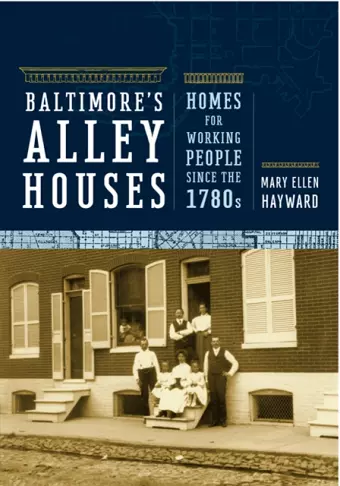
Mary Ellen Hayward tells the story of how immigrants found the American dream of owning a home through the unique invention of row houses-which made homes affordable and accessible and built a community that made Baltimore such a vibrant mosaic of neighborhoods. -- Senator Barbara A. Mikulski
Featuring more than one hundred historic images, Baltimore's Alley Houses documents the changing architectural styles of low-income housing over two centuries and reveals the complex lives of its residents.This pioneering study explains how one of America's important early cities responded to the challenge of housing its poorer citizens. Where and how did the working poor live? How did builders and developers provide reasonably priced housing for lower-income groups during the city's growth? Having studied over 3,000 surviving alley houses in Baltimore through extensive land records and census research, Mary Ellen Hayward systematically reconstructs the lives, households, and neighborhoods that once thrived on the city's narrowest streets. In the past, these neighborhoods were sometimes referred to as "dilapidated," "blighted," or "poverty stricken." In Baltimore's Alley Houses, Hayward reveals the rich cultural and ethnic traditions that formed the African-American and immigrant Irish, German, Bohemian, and Polish communities that made their homes on the city's alley streets. Featuring more than one hundred historic images, Baltimore's Alley Houses documents the changing architectural styles of low-income housing over two centuries and reveals the complex lives of its residents.
Engagingly written and well researched. -- Diane Scharper Baltimore Sun 2008 Throughout Baltimore's Alley Houses, the writing betrays the author's affection for Baltimore and its old, often-decayed houses... In the book's epilogue, Hayward writes that '[t]he memories are worth saving. They cannot be replaced' (265). Her book is itself an important document for maintenance of those memories and of the material culture from which they are derived. -- Jeremy Kargon Maryland Historical Magazine & MHS Publications 2009 A well-illustrated architectural and social history. -- Laura B. Driemeyer Buildings and Landscapes 2010
- Winner of Abbott Lowell Cummings Prize 2009 (United States)
- Winner of Maryland Preservation Awards: Heritage Book 2009 (United States)
ISBN: 9780801888342
Dimensions: unknown
Weight: 998g
328 pages