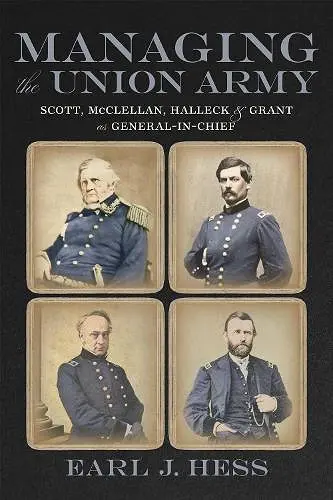
Managing the Union Army
Scott, McClellan, Halleck, and Grant As General-in-Chief
Format:Hardback
Publisher:Louisiana State University Press
Published:14th Oct '26
Should be back in stock very soon
The general-in-chief did not command the million-man Union army that fought in the Civil War, as most historians have assumed; rather, he was a member of a management team that included the president and the secretary of war. The president, as commander-in-chief, created the position by appointing an officer to it, and he could dismiss that officer at any time and choose not to appoint another. The general-in-chief had to cooperate closely with the president and the secretary of war to ensure the team functioned effectively.
In Managing the Union Army, renowned Civil War historian Earl J. Hess upends our understanding of the general-in-chief, his role in the Union military system, and his influence on the conflict's outcome. Hess reinterprets the accomplishments and failures of the four men who held the position, evaluating Winfield Scott, George B. McClellan, Henry W. Halleck, and Ulysses S. Grant in ways that might surprise many students of Civil War military history.
The Union general-in-chief could take on four major responsibilities. The first was to serve as a military advisor to the president and the secretary of war. The second was to develop policies to govern the huge Union army. The third was to recommend officers to command corps, field armies, and military departments. The fourth was to actually command a portion of the army in field operations, a role that Grant alone fulfilled. Hess shows how the performance of the four men varied greatly across the three other tasks. He also details Grant's unique achievement as a field commander—ending the war, which none of the other Union generals-in-chief were able to do.
Hess illuminates how personality traits helped or hindered the generals-in-chief during the war. McClellan's deeply flawed personality contributed to his failure in fulfilling the duties of the position. Grant's strongly positive personality and will-do attitude, by contrast, helped him to succeed more fully in the role than any of his predecessors.
Hess also offers a much more positive evaluation of Halleck than is typical of the scholarly literature on Civil War commanders. Halleck was not only a successful general-in-chief but also fundamentally supported Grant during the last year of the conflict by serving...
"In this volume, Earl J. Hess examines the often-misinterpreted role of the United States Army's general-in-chief during the Civil War. Noting saliently that neither constitutional nor legislative authority had authorized the office of general-in-chief, the author crafts an incisive analytical framework in the assessment of the four generals who served their civilian leaders in the management of the largest conflict ever undertaken on American soil. This is a rewarding book, one that will remain essential in understanding the unique, bounded nature of Civil War high-level command." - Christopher S. Stowe, Command and Staff College, Marine Corps University
"Hess convincingly demonstrates the evolution of a poorly defined position into a crucial Union advantage. This post depended on individuals and did not survive the war, but Henry Halleck provided the hands-on management that Winfield Scott lacked, and Grant delivered the willingness to work with Lincoln, the field experience, and the national strategic plan that his predecessors lacked. This detailed analysis of Union strategy and top-level civil-military relations shows that McClellan (like the Confederate generals) lacked the national perspective needed, while Grant's confidence and humility made him the indispensable man." - Samuel J. Watson, editor of The Oxford Handbook of American Military History
"In numerous prior works, Earl Hess has shown us the internal mechanisms of Civil War military life, making possible an understanding of those mechanisms as the soldiers of the Civil War saw them. In this new work, Hess adopts a different perspective—what we might call the thirty-thousand-foot view of the Civil War—as he examines the four Union generals who held the top military post as general-in-chief: Winfield Scott, George B. McClellan, Henry Wager Halleck, and Ulysses S. Grant. Hess accomplishes two important tasks: first, he explains how each of the generals-in-chief undertook this responsibility, and then he evaluates their performance. In his customary fashion, Hess asks precisely the questions that were pressing and evident to the war's participants, but which time and the modernization of warfare have rendered invisible. Managing the Union Army is an important contribution to Civil War military history in particular, and American military history in general." - Allen C. Guelzo, author of Abraham Lincoln: Redeemer President
ISBN: 9780807185230
Dimensions: 229mm x 152mm x 32mm
Weight: unknown
480 pages