From the Center of America
Steamboats and Shipyards Along the Lower Ohio River
Format:Hardback
Publisher:Southern Illinois University Press
Published:31st May '26
£40.00
Supplier delay - available to order, but may take longer than usual.
This hardback is available in another edition too:
- Paperback£22.99(9780809339839)
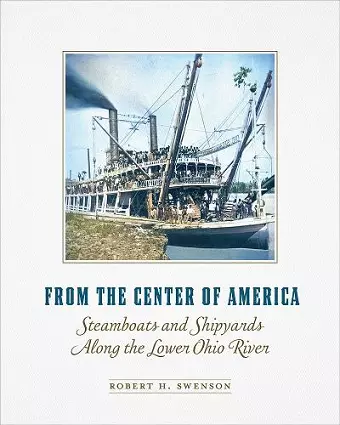
Charting the legacy of mid-America's shipyards and iconic steamboats
Before the railroad stitched together the American landscape, the dominant mode of transportation in the United States was by steamboat. These grand vessels, their iconic paddlewheels churning the country's rivers, have long captured the national imagination as symbols of innovation and adventure.
In the heart of America, four major rivers converge—the Cumberland and Tennessee with the Ohio; then the Ohio with the Mississippi. These three confluences, which author Robert Swenson christens the Four Rivers Reach, played a unique role in the development of the steamboats that dominated American continental transport for almost 100 years. Between 1825 and 1936, the river towns of Smithland, Paducah, Metropolis, Mound City, and Cairo launched 295 wood-hulled, steam-powered vessels. Drawing from a wealth of archival sources, Swenson presents detailed histories of these steamboats over a span of 110 years, accompanied by nearly one hundred illustrations and photographs.
The book focuses on distinct events in steamboat history, tracing the impact of these shipyards on the economies and communities of the river towns where they were built. It reveals how the availability of steamboats along this sixty-mile Reach affected migration, politics, and the US economy of the nineteenth century. Steamboats built at the Four Rivers Reach played pivotal roles in the forced relocation of Native Americans from southern Appalachia to Oklahoma, the outcome of the Civil War, and the Montana gold rush. From the Center of America demonstrates how steamboat building shaped the culture, people, and economy of this region—and how, in turn, the area and its steamships influenced the growth of the young United States.
"Since the days of Mark Twain, Americans have been fascinated by the world of the riverboats that once travelled the heartland's waterways. With From the Center of America, Robert Swenson gives us a gift that invigorates that romance. His is a labor of love inspired by childhood memories of that riverine world and informed by decades of research. Readers of the region and the nation at large will thank him for his labors."— Michael C. Batinski, author of Forgetting and the Forgotten: A Thousand Years of Contested Histories in the Heartland
"Swenson brings the towns and shipyards of the Reach to life. This book is essential reading for understanding the great steamboat era, the impact of the Civil War, and the transportation history of our expanding Republic."— Ken Robison, historian, Overholser Historical Research Center, Fort Benton
"The product of two decades of meticulous research, Robert Swenson's book is a welcome addition to our understanding of the Lower Ohio River Valley, its boatbuilding, and its national trade connections. The four rivers of the region were critical to the development of the Midwest, the South, and the Great Plains. Swenson paints a vivid historical canvas against the backdrop of national events, enabling us to witness the interactions of trade, culture, and politics underlying the expansion of America."— Paul A. Tenkotte, chair, History and Heritage Committee, Ohio River Way
"Robert Swenson's long-anticipated book about steamboat construction on the Ohio, Mississippi, Cumberland, and Tennessee rivers is a landmark study we hope will inspire historians and archaeologists to get their hands dirty exploring this lost era in American industry. The rivers still have much to reveal about the boats that plowed them, and Swenson, an architect and teacher by profession, is exactly the right person to take us on this muddy-water journey. Though the steamboat era is a memory, this book is a whistle call to all those still standing on the pier waiting to take a ride into history."— William Furry, executive director, Illinois State Historical Society
ISBN: 9780809339907
Dimensions: 229mm x 152mm x 17mm
Weight: 767g
248 pages
New edition