Sprawling Places
Rethinking Modern Urban Environments and Their Impacts
Format:Paperback
Publisher:University of Georgia Press
Published:25th Jan '08
Should be back in stock very soon
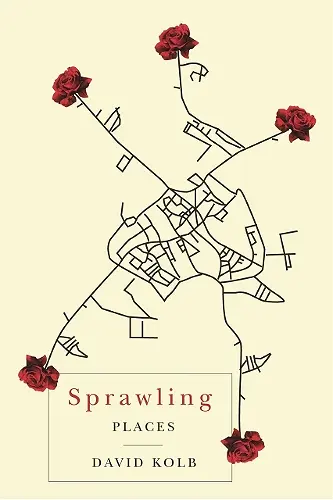
In Sprawling Places, David Kolb challenges the negative perceptions of modern urban environments, advocating for a deeper understanding of their complexity and potential.
In Sprawling Places, David Kolb delves into the often criticized landscapes of contemporary America, such as malls, suburban strips, and subdivisions. While many lament the proliferation of these spaces, Kolb challenges the prevailing notion that they are merely undesirable 'nonplaces.' He argues that dismissing these environments overlooks their complexity and the potential for meaningful human interaction within them.
Kolb acknowledges the shortcomings of many modern developments, recognizing their sometimes bland exteriors. However, he emphasizes that these places can foster intricate connections and diverse uses. By shifting the focus from aesthetic judgments to a deeper understanding of how people engage with their surroundings, Kolb invites readers to reconsider what defines a place. He posits that it is not the physical attributes alone but the activities and interactions that occur within these spaces that truly shape their identity.
Drawing on the insights of influential thinkers like Henri Lefebvre and Manuel Castells, Sprawling Places advocates for a more nuanced conversation about urban development. Kolb aims to move beyond the binary choice of local versus sprawling spaces, urging a recognition of the richness of contemporary environments. His work encourages readers to appreciate the potential for better design and a more thoughtful approach to the built environment, ultimately enriching our understanding of where we live and how we connect with one another.
The central idea—to provide a critical analysis of new kinds of places, and to offer a defense of them against standard objections—is timely and interesting. Kolb makes effective use of the relevant philosophical and social science literature and provides numerous useful examples. Sprawling Places will find an audience among cultural theorists and analysts of popular culture, philosophers, architects, and urban designers and planners.
-- William J. Mitchell * author of Placing Words: Symbols, Space, and the City *Making better places involves more than just improving the architecture—it means being attentive to the social interactions, norms, and meanings generated by a given location. In Sprawling Places David Kolb employs this idea to help us assess and re-assess a variety of contemporary places, from theme parks to traditional suburbs to New Urbanist developments. Kolb asks us to move beyond totalizing critiques of suburban places, and instead evaluate places according to the level of complexity they exhibit and the kinds of social meanings and practices they promote. He shows how this framework can help us think not just critically but constructively about suburban places and how they might be improved by creative interventions, ranging from subtle changes in street-level details to larger-order policy reforms. Theoretically rich yet highly engaging, Sprawling Places offers a fresh and surprisingly hopeful contribution to our understanding of suburban life.
-- Thad Williamson * coauthor of Making a Place for Community: Local Democracy in a Global Era *In this polemic, philosopher and place theorist David Kolb deploys more unconventional thinking in the service of what turn out to be common sense ideas. Kolb finds distinctions where others assume homogeneity; his baseline act of discernment is to recognize that suburbs are neither small villages or large cities, and therefore should be approached as unique phenomena.
-- New Haven ReviewFlexible interpretations of sprawl are necessary on a planet that shows no signs of divorcing itself from its cars and suburbs, and Kolb provides some imaginative and theoretical tools for reconsidering, with fewer prejudices, both fragmentation and polycentrism.
-- Net American CityISBN: 9780820329895
Dimensions: 229mm x 152mm x 19mm
Weight: 413g
280 pages