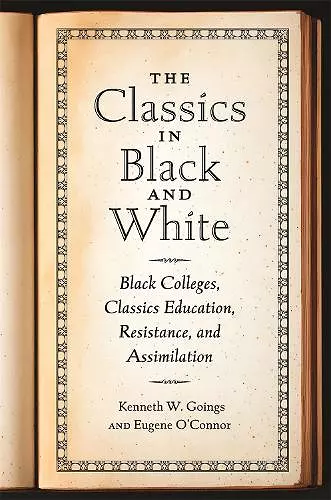
The Classics in Black and White
Black Colleges, Classics Education, Resistance, and Assimilation
Eugene O'Connor author Kenneth W Goings author
Format:Paperback
Publisher:University of Georgia Press
Published:15th May '24
Should be back in stock very soon
A study of the classics curriculum in Black colleges formed after the Civil War
Following emancipation, African Americans continued their quest for an education by constructing schools and colleges for Black students, mainly in the U.S. South, to acquire the tools of literacy, but beyond this, to enroll in courses in the Greek and Latin classics, then the major curriculum at American liberal arts colleges and universities.
Following emancipation, African Americans continued their quest for an education by constructing schools and colleges for Black students, mainly in the U.S. South, to acquire the tools of literacy, but beyond this, to enroll in courses in the Greek and Latin classics, then the major curriculum at American liberal arts colleges and universities. Classically trained African Americans from the time of the early U.S. republic had made a link between North Africa and the classical world; therefore, from almost the beginning of their quest for a formal education, many African Americans believed that the classics were their rightful legacy.
The Classics in Black and White is based extensively on the study of course catalogs of colleges founded for Black people after the Civil War by Black churches, largely White missionary societies and White philanthropic organizations. Kenneth W. Goings and Eugene O’Connor uncover the full extent of the colleges’ classics curriculums and showcase the careers of prominent African American classicists, male and female, and their ultimately unsuccessful struggle to protect the liberal arts from being replaced by Black conservatives and White power brokers with vocational instruction such as woodworking for men and domestic science for women. This move to eliminate classics was in large part motivated by the very success of the colleges’ classics programs. As Goings and O’Connor’s survey of Black colleges’ curriculums and texts reveals, the lessons they taught were about more than declensions and conjugations—they imparted the tools of self-formation and self-affirmation.
The Classics in Black and White highlights the way public education and public classical education developed to support Black liberation and citizenship. This is especially important in a time when we see so many more inroads being made to dismantle public education because it is the great equalizer for racial and economic justice in the United States. Goings and O'Connor reveal many of the reasons behind this continued push and the White supremacism that is the root.
-- Rebecca Futo Kennedy * author of Immigrant Women in Athens: Gender, Ethnicity, and Citizenship in the Classical City *I have been craving a book like this one! Having yielded ample rewards before, the collaboration between Goings and O’Connor delivers once again, this time with a study that details the (shifting and sometimes star-crossed) commitment of Black colleges and universities to humanistic and specifically classical education in the seventy years that bridged Reconstruction to the eve of World War II.
-- Dan-el Padilla Peralta * author of Undocumented: A Dominican Boy’s Odyssey from a Homeless Shelter to the Ivy League *Scholars will find it a handy supplement to specialist works such as Henry N. Drewry and Humphrey Doermann’s Stand and Prosper: Private Black Colleges and Their Students (Princeton, 2001) and Margaret Malamud’s African Americans and the Classics: Antiquity, Abolition and Activism.
* The Journal of Southern History *Goings and O’Connor challenge entrenched assumptions about the role of classical education in Black intellectual traditions, presenting such education not as a passive inheritance but as a dynamic terrain for appropriation, negotiation, and subversion. By compelling readers to reconsider the epistemic legacies of classical studies within historically marginalized communities, the book opens new avenues for research and debate.
* The Journal of African American HistoISBN: 9780820366623
Dimensions: unknown
Weight: unknown
192 pages