Cuban Tobacco in the Age of Second Slavery
Format:Hardback
Publisher:University of Georgia Press
Published:15th Jun '26
£135.95
Supplier delay - available to order, but may take longer than usual.
This hardback is available in another edition too:
- Paperback£34.95(9780820376899)
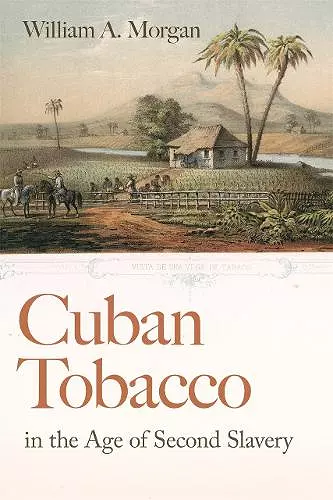
An exploration of the creation and development of tobacco as part of Cuba’s plantation economy
Arguing tobacco was more counterpart than counterpoint to sugar, Cuban Tobacco in the Age of Second Slavery focuses on the development of tobacco as a plantation economy—and the exponential increase in forced labor supporting it—to suggest an alternative narrative in understanding both Cuban and Atlantic slavery in this period.
By 1865, more than 750,000 enslaved Africans had arrived in Cuba, making it the leading Spanish American slave colony and the epicenter of slavery in the Atlantic. At the height of the global tobacco economy, tens of thousands of these slaves labored in Pinar del Río, Cuba—a region devoted exclusively to tobacco cultivation. These enslaved people were responsible for exporting a record fourteen million pounds of raw tobacco per year, leaving one contemporary writer to argue that no agricultural economy produced more value, in proportion to the capital and labor employed, than tobacco. While tobacco was second only to sugar in export significance and in the number of rural enslaved, tobacco was unequivocally as dependent on enslaved labor as the more infamous export. Despite Cuba being one of the first-introduced and last-abolished slave societies in the Atlantic world, this slave economy remains largely ignored, existing outside the considerable and recent scholarship on the region.
Cuban Tobacco in the Age of Second Slavery directly refutes the myth of tobacco as a small-scale, family, and free-labor crop promoted by both contemporary and current scholarship. It also rejects the prevailing use of sugar as the model for epitomizing Cuban slavery—a paradigm that obscures the full measure of diversity in this region and era. Arguing tobacco was more counterpart than counterpoint to sugar, Cuban Tobacco in the Age of Second Slavery focuses on the development of tobacco as a plantation economy—and the exponential increase in forced labor supporting it—to suggest an alternative narrative in understanding both Cuban and Atlantic slavery in this period.
Drawing on meticulous original research, in itself a significant contribution to a growing body of scholarship on slavery in Cuban tobacco, Morgan mounts a convincing case for rethinking tobacco as integral to our understanding of Cuba during the Age of Second Slavery.
-- Jean Stubbs * author of Tobacco on the Periphery: A Case Study in Cuban Labour History, 1860-1958 and Tobacco Counterpoints: Cuba and the Global Habano *Cuban Tobacco in the Age of Second Slavery has all the advantages of a broad book with a new perspective from the enslaved. It is both a micro-perspective on the best tobacco in the world and is interdisciplinary and international. It is a very important book.
-- Michael Zeuske * author of Amistad: A Hidden Network of Slavers and Merchants *Cuban Tobacco in the Age of Second Slavery stands to make a major contribution to the history of plantation economies in Cuba and the Atlantic World.
-- Takkara K. Brunson * author of Black Women, Citizenship, and the Making of Modern CuISBN: 9780820376929
Dimensions: unknown
Weight: unknown
300 pages