Permeable Border
The Great Lakes Basin As Transnational Region 1650-1990
David Smith author Randy William Widdis author John J Bukowczyk author Nora Faires author
Format:Hardback
Publisher:University of Pittsburgh Press
Published:20th Sep '05
Should be back in stock very soon
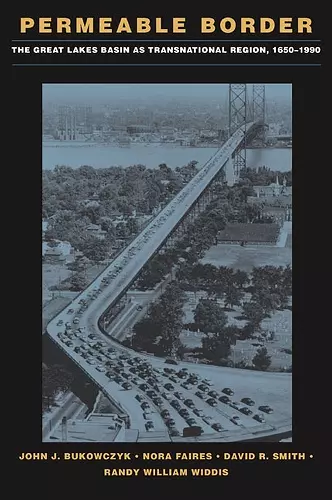
This text examines the history of the Great Lakes Basin in relation to its importance as a place of social, economic, and political interaction between the United States and Canada.
Winner of the 2006 Albert B. Corey Prize from the American Historical Association.
Available in Canada through University of Calgary Press
This text examines the history of the Great Lakes Basin in relation to its importance as a place of social, economic, and political interaction between the United States and Canada. Winner of the 2006 Albert B. Corey Prize from the American Historical Association. Available in Canada through University of Calgary Press
From the colonial era of waterborne transport, through nineteenth-century changes in transportation and communication, to globalization, the history of the Great Lakes Basin has been shaped by the people, goods, and capital crossing and recrossing the U.S.-Canadian border. During the past three centuries, the region has been buffeted by efforts to benefit from or defeat economic and political integration and by the politics of imposing, tightening, or relaxing the bisecting international border. Where tariff policy was used in the early national period to open the border for agricultural goods, growing protectionism in both countries transformed the border into a bulwark against foreign competition after the 1860s. In the twentieth century, labor migration followed by multinational corporations fundamentally altered the customary pairing of capital and nation to that of capital versus nation, challenging the concept of international borders as key factors in national development. In tracing the economic development of the Great Lakes Basin as borderland and as transnational region, the authors of Permeable Border have provided a regional history that transcends national borders and makes vital connections between two national histories that are too often studied as wholly separate.
"Permeable Border offers a fresh, thought-provoking inquiry into the history of U.S.-Canadian relations. Examining economic development, migration, and national policies, these essays throw light on the changing patterns of cross-border interaction in the Great Lakes region since 1800. This book will be essential reading for scholars interested in an integrated view of North American history, and makes a valuable contribution to contemporary debates over globalization.
* Christopher Clark, University of Connecticut *A work of impeccable scholarship and painstaking research . . . a seminal benchmark reference for the significant activity on the Great Lakes for trade between its most active years of 1650 and 1990.
* Midwest Book Review *An exemplary collaborative effort in which the authors combine their respective specialties in U.S. and Canadian history with a view to remapping the Great Lakes border region and confer it new historical meaning, drawing skillfully from recent transnational perspectives.
* Bruno Ramirez, author of Crossing the 49th Parallel: Migration from Canada to the United States, 1900-1930ISBN: 9780822942610
Dimensions: unknown
Weight: unknown
312 pages