Destined for the Stars
Faith, the Future, and America's Final Frontier
Format:Hardback
Publisher:University of Pittsburgh Press
Published:28th May '19
Should be back in stock very soon
Divine Destiny and the Popularization of Space Exploration in America
Divine Destiny and the Popularization of Space Exploration in America
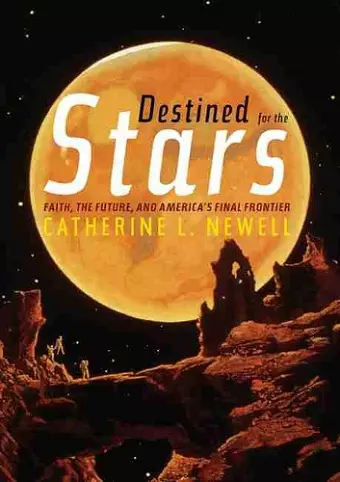
Where did humanity get the idea that outer space is a frontier waiting to be explored? Destined for the Stars unravels the popularization of the science of space exploration in America between 1944 and 1955, arguing that the success of the US space program was due not to technological or economic superiority, but was sustained by a culture that had long believed it was called by God to settle new frontiers and prepare for the inevitable end of time and God’s final judgment. Religious forces, Newell finds, were in no small way responsible for the crescendo of support for and interest in space exploration in the early 1950s, well before Project Mercury—the United States’ first human spaceflight program—began in 1959.
In this remarkable history, Newell explores the connection between the art of Chesley Bonestell—the father of modern space art whose paintings drew inspiration from depictions of the American West—and the popularity of that art in Cold War America; Bonestell’s working partnership with science writer and rocket expert Willy Ley; and Ley and Bonestell’s relationship with Wernher von Braun, father of both the V-2 missile and the Saturn V rocket, whose millennial conviction that God wanted humankind to leave Earth and explore other planets animated his life’s work. Together, they inspired a technological and scientific faith that awoke a deep-seated belief in a sense of divine destiny to reach the heavens. The origins of their quest, Newell concludes, had less to do with the Cold War strife commonly associated with the space race and everything to do with the religious culture that contributed to the invention of space as the final frontier.
In her convincing debut, today. Newell has produced a forceful, original view of the American quest for the 'final frontier.'
* Publishers Weekly *The true value of this book is . . . in its ability to synthesize a vast amount of information while adding fascinating details about Bonestell and von Braun to establish a kind of hybrid lineage of thinking about space, rooted in science, religion, and exceptionalism.
* Isis *Catherine Newell’s book is full of lively writing and refreshing analysis. Destined for the Stars will likely delight fans of popular culture in the early space age.
* Journal for the History of Astronomy *Newell . . . engages deeply with the academic study of religion and science, but her book is written in a way that is accessible to both academic and general readers. She makes serious historical claims that contribute to the discipline, but she also patiently guides those who do not know much about the history of religion, science, and the space race.
* Reading Religion *Newell’s prose is clean, conveying great detail and wide-ranging discursions without muddying the core narrative or stumbling into literary cul-de-sacs . . . a casual amateur will be able to take away as much from its novel argument as will a seasoned historian of either space exploration or postwar America.
* Quest *Destined for the Stars is well conceived, splendidly narrated, and cleverly argued. It makes a genuine contribution to both the history of science and technology and American religious history, with rare potential to change one of the shibboleths of American popular and scholarly history—that America embarked on space exploration to beat the Soviet Union to the moon.
-- James Hudnut-BeumlerThis is a stunning book about faith in a glorious future, nostalgia for a heroic past, and an ever-present quest to become a multiplanetary species. Catherine Newell reveals that support for human space exploration is often about a ‘higher purpose’; it inspires faith, worship, reverence, alternative futures, and a quest for secular immortality. A fascinating contribution to the history of spaceflight.
-- Roger Launius, former chief historian ofISBN: 9780822945567
Dimensions: unknown
Weight: unknown
304 pages