Foucault in Brazil
Dictatorship, Resistance, and Solidarity
Format:Hardback
Publisher:University of Pittsburgh Press
Published:10th Jun '24
Should be back in stock very soon
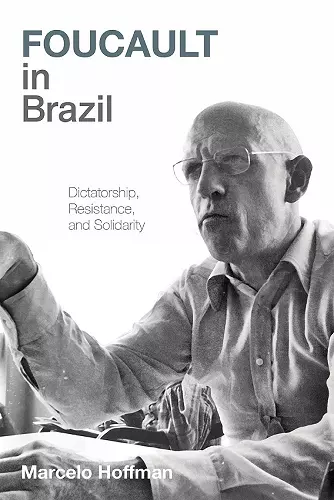
Captures the Complexity of Foucault’s Political Engagements and Breaks with the Orthodox View That He Was Anti-Marxist
Although a coup in 1964 had installed a military dictatorship, Foucault kept his opinion on the Brazilian government largely to himself until October 23, 1975. Marcelo Hoffman connects history, philosophy, and political theory to open new ways of thinking about Foucault as a person and thinker and about Brazil and authoritarianism.Philosopher Michel Foucault’s cultural criticism crosses disciplines and is well known as an influence on modern conceptions of knowledge and power. Less well known are the five trips he took to Brazil between 1965 and 1976\. Although a coup in 1964 had installed a military dictatorship, Foucault kept his opinion on the Brazilian government largely to himself until October 23, 1975\. On that date, he delivered a manifesto at a student assembly in São Paulo expressing his solidarity with students and professors protesting a wave of arrests and torture. This manifesto caught the government’s attention and became the focal point of the dictatorship’s surveillance of Foucault. Foucault in Brazil explores the production of the public antagonism between the philosopher and the dictatorship through a meticulous consideration of each of his visits to Brazil. Marcelo Hoffman connects history, philosophy, and political theory to open new ways of thinking about Foucault as a person and thinker and about Brazil and authoritarianism.
Hoffman has provided not only a meticulous historical account of these visits and their broader context, but has opened a window onto the manner in which the political and intellectual worlds of France and Brazil converged at decisive historical junctures—to confront torture, repression, and dictatorship, and to elaborate modes of
resistance in both theory and praxis.
Foucault in Brazil: Dictatorship, Resistance, and Solidarity, to the extent that it is replete with details and the memory of a politically engaged Foucault in Brazil, is a substantial contribution to the description of resistance in his political trajectory as well as the manner in which his thought could be influenced by the exercise of political activity in countries other than those of Western Europe.
* Dilemas, Revista de Estudos de Conflito e Controle Social *As a contextual intellectual history, Hoffman's book situates Foucault in the arc of the Brazilian dictatorship and synthesizes a wide array of scholarship that will be useful to those less familiar with it. Latin America clearly mattered to Foucault, and Foucault mattered and still matters to many Latin Americans. Hoffman tells us about how this came to be.
* Hispanic American Historical Review *Hoffman has provided us with an invaluable guide, a major contribution to Foucault scholarship and more generally to the reception of French theory abroad.
* Political Theory *His book should be read by anyone interested in Foucault’s intellectual development, particularly those interested in how Foucault sought to bring together his philosophical work with his intellectual praxis.
* Journal of French and Francophone Philosophy *Marcelo Hoffman’s Foucault in Brazil: Dictatorship, Resistance, and Solidarity is meticulous and exemplary scholarship that deserves a wide audience for recontextualizing and clarifying Foucault’s politics and intellectual development.
* Foucault Studies *Without a doubt, it stands as an essential contribution for the academic community, students and readers interested in political theory, the history of Latin America and the universal legacy of Foucault.
* Eikasia: Revista de Filosofia *Foucault in Brazil contributes significantly to the existing literature.
* Bulletin of Latin American Research *Hoffman reveals how Brazil was key to the development and elaboration of his own ideas on biopolitics and health. His succinct descriptions are a useful introduction to some of Foucault’s key ideas, which he uses to illuminate how they contributed to and were expanded by Brazilians' own intellectual and political activism.
* CHOICE *Brilliant and chock-full of insights and impeccably researched historical portraits, Foucault in Brazil is a luminous, indispensable book in a range of fields, and constitutes a landmark for scholars interested in the French philosopher in the continent and beyond.
-- Adam Joseph Shellhorse, Temple UniverISBN: 9780822948063
Dimensions: unknown
Weight: unknown
200 pages