Empire And Antislavery
Spain Cuba And Puerto Rico 1833-1874
Christopher Schmidt-Nowara author
Format:Paperback
Publisher:University of Pittsburgh Press
Published:6th May '99
Should be back in stock very soon
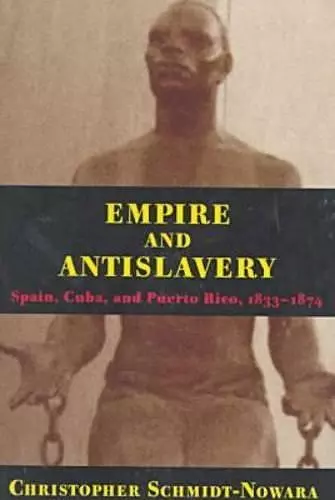
Based on research in Spain, Cuba, Puerto Rico, and the United States, this book aims to reconstruct how abolitionism arose as a critique of the particular structures of capitalism and colonialism in Spain and the Antilles. More generally, it tells a story central to slavery, race, and empire.
In 1872, there were more than 300,000 slaves in Cuba and Puerto Rico. Though the Spanish government had passed a law for gradual abolition in 1870, slaveowners, particularly in Cuba, clung tenaciously to their slaves as unfree labor was at the core of the colonial economies. Nonetheless, people throughout the Spanish empire fought to abolish slavery, including the Antillean and Spanish liberals and republicans who founded the Spanish Abolitionist Society in 1865. This book is an extensive study of the origins of the Abolitionist Society and its role in the destruction of Cuban and Puerto Rican slavery and the reshaping of colonial politics.
Empire and Antislavery surpasses anything available in English on the dynamic political interaction between metropolis and colonies that led to the ending of slavery in Cuba and Puerto Rico. It should become required reading for graduate seminars on the history of Spain and Latin America as well as of slavery and abolition.
* Robert L. Paquette, Hamilton College *In this excellent study based on extensive archival research and a thorough reading of secondary material, Christopher Schmidt-Nowara meticulously analyzes the tortuous route of Spanish abolition.
* The International History Review *A must for students and scholars.
* Florida Historical Quarterly *It is a thoroughly researched study that moves beyond the 'us-against-them' model that has characterized much of the earlier scholarship, forcing scholars to recognize a more complex Spain, whose various economic and social actors clashed to produce contradictory and seemingly bizarre colonial policies.
* Colonial Latin American Historical Review *His is a long and well thought out enquiry into the legitimacy of the revolutionary regime and the dissolution of tensions in colonial societies, which began in 1830.
* The Journal of European Economic History *Studies the experience of peasant communities in the [El Salvador] Republic in the light of changing internal and external forces and focuses on such features as land use, agrarian exports, rural class stratification, political conflict and ethnicity. . . . The book makes a valuable contribution to the economic and social history of one of the least known countries in Latin America. If it does not rewrite nineteenth and twentieth century economic history in the region, the book does reveal the importance of local and micro studies to macro debates.
* European Review of Latin American and Caribbean StudiesISBN: 9780822956907
Dimensions: unknown
Weight: unknown
256 pages