Salt and the Colombian State
Local Society and Regional Monopoly in Boyaca, 1821-1900
Format:Paperback
Publisher:University of Pittsburgh Press
Published:30th Jan '12
Should be back in stock very soon
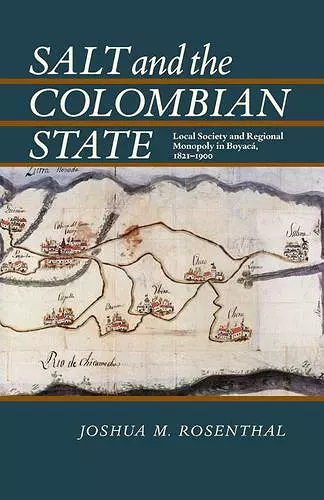
In republican Colombia, salt became an important source of revenue not just to individuals, but to the state, which levied taxes on it and in some cases controlled and profited from its production. Focusing his study on the town of La Salina, Joshua M. Rosenthal presents a fascinating glimpse into the workings of the early Colombian state, its institutions, and their interactions with local citizens during this formative period.
In republican Colombia, salt became an important source of revenue not just to individuals, but to the state, which levied taxes on it and in some cases controlled and profited from its production. The salt trade consistently accounted for roughly ten percent of government income.
In the town of la Salina de Chita, in Boyac\u00e1 province, thermal springs offered vast amounts of salt, and its procurement and distribution was placed under the jurisdiction of the Ministry of Finance. Focusing his study on la Salina, Joshua M. Rosenthal presents a fascinating glimpse into the workings of the early Colombian state, its institutions, and their interactions with local citizens during this formative period. Although historians have cited the stateÆs weakness, and in many cases, its absence in local affairs, Rosenthal counters these assumptions by documenting the primary role the state held in administering contracts, inspections, land rights, labor, and trade in la Salina, and contends that this was not an isolated incident. He also uncovers the frequent interaction between the state and local residents, who used the stateÆs liberal rhetoric to gain personal economic advantage.
Seen through the lens of the administration of la SalinaÆs salt works, Rosenthal provides a firsthand account of the role of local institutions and fiscal management in the larger process of state building. His study offers new perspectives on the complex network of republican ColombiaÆs political culture, and its involvement in provincial life across the nation.
Rosenthal has identified a significant subject that had hitherto remained largely ignored by the literature, and his book is a major contribution to modern Colombian historiography.
* Journal of Latin American Studies *"Salt and the Colombian State is the best sort of local history, as the story of the La Salina saltworks wonderfully illuminates the larger history of nineteenth-century nation and state formation. Rosenthal adroitly demonstrates how the weak state still profoundly affected demography, land holding, labor opportunities, social structure, and even the daily lives of many Colombians. Rosenthal convincingly argues that the relations between state and society are crucial to understanding nineteenth-century Spanish America, providing a lasting contribution to Latin American historiography."
* James Sanders, Utah State University *This richly researched book provides a new and important perspective on the state as a daily economic actor. It masterfully shows how local people and national politicians experienced the contradictions between antimonopoly ideologies and fiscal realities. It should be read by anybody interested in the history of state building and economic change in Latin America.
* Marixa Lasso, Case Western Reserve UniversiISBN: 9780822961802
Dimensions: unknown
Weight: unknown
240 pages