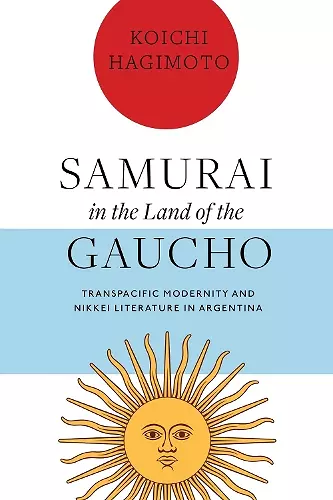
Samurai in the Land of the Gaucho
Transpacific Modernity and Nikkei Literature in Argentina
Format:Paperback
Publisher:Vanderbilt University Press
Published:30th Jul '23
Currently unavailable, and unfortunately no date known when it will be back
The Argentine vision of “transpacific modernity” was in part informed by historical imaginings of Japan in the early twentieth century. Intellectuals such as Eduardo Wilde and Manuel Domecq GarcÍa celebrated Japanese customs and traditions as important values that can be integrated into Argentine society. But a new generation of Nikkei or Japanese Argentines is rewriting this conventional narrative in the twenty-first century. Nikkei writers such as Maximiliano Matayoshi and Anna Kazumi Stahl are challenging the earlier, unapologetic view of Japan based on their own immigrant experiences.
Compared to the experience of political persecution against Japanese immigrants in Brazil and Peru, the Japanese in Argentina generally lived under a more agreeable sociopolitical climate. In order to understand the “positive” perception of Japan in Argentine history and literature, Samurai in the Land of the Gaucho turns to the current debate on race in Argentina, particularly as it relates to the discourse of whiteness. One of the central arguments is that Argentina’s century-old interest in Japan represents a disguised method of (re)claiming its white, Western identity.
Through close readings of diverse genres (travel writing, essay, novel, short story, and film) Samurai in the Land of the Gaucho yields a multi-layered analysis in order to underline the role Japan has played in both defining and defying Argentine modernity from the twenty century to the present.
“Samurai in the Land of the Gaucho is an engaging exploration of race and identity in Argentine national culture, and the paradoxical place of the Japanese in this construction."—Evelyn Hu-DeHart, editor of Across the Pacific: Asian Americans and Globalization
"Well-researched and lucid, Hagimoto provides an unexpected perspective on traditional Argentine narratives of whiteness, which, after the 2022 Qatar World Cup, have generated international interest. By reading texts from the late 19th century to the present, by Euro-Argentines and Japanese immigrants and their descendants, Samurai in the Land of the Gaucho problematizes Argentine literature and identity and the notion of a uniform Asian immigrant experience."—Juan E. De Castro, author of Writing Revolution in Latin America: From MartÍ to GarcÍa MÁrquez to BolaÑo
“Hagimoto makes visible a significant portion of formerly marginalized aesthetic and documentary practices and proposes a new understanding of transnational Nikkei subjectivity in Latin America. The volume produces a rich understanding of a wide array of literary, archival, and cinematic texts by juxtaposing Argentina’s discourse of whiteness and Japan’s history of Westernization.”—Gorica Majstorovic, author of Global South Modernities: Modernist Literature and the Avant-Garde in Latin America
"This is an excellent and most needed study. Hagimoto’s knowledge of Transpacific Studies and languages (English, Japanese, and Spanish) is unequaled by his peers."—Anceli Tinajero, author of A Cultural History of Spanish Speakers in Japan
ISBN: 9780826505699
Dimensions: unknown
Weight: 363g
188 pages