From Empire to Eurasia
Politics, Scholarship, and Ideology in Russian Eurasianism, 1920s-1930s
Format:Paperback
Publisher:Cornell University Press
Published:31st Oct '17
Currently unavailable, and unfortunately no date known when it will be back
This paperback is available in another edition too:
- Hardback£36.00(9780875807508)
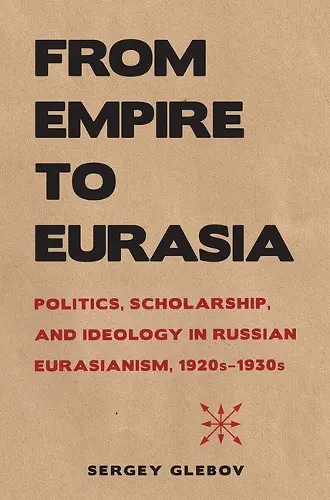
The Eurasianist movement was launched in the 1920s by a group of young Russian émigrés who had recently emerged from years of fighting and destruction. Drawing on the cultural fermentation of Russian modernism in the arts and literature, as well as in politics and scholarship, the movement sought to reimagine the former imperial space in the wake of Europe’s Great War. The Eurasianists argued that as an heir to the nomadic empires of the steppes, Russia should follow a non-European path of development. In the context of rising Nazi and Soviet powers, the Eurasianists rejected liberal democracy and sought alternatives to Communism and capitalism. Deeply connected to the Russian cultural and scholarly milieus, Eurasianism played a role in the articulation of the structuralist paradigm in interwar Europe. However, the movement was not as homogenous as its name may suggest. Its founders disagreed on a range of issues and argued bitterly about what weight should be accorded to one or another idea in their overall conception of Eurasia. In this first English language history of the Eurasianist movement based on extensive archival research, Sergey Glebov offers a historically grounded critique of the concept of Eurasia by interrogating the context in which it was first used to describe the former Russian Empire.
"This book is a long-awaited culmination of several years of articles and, most recently, a Russian-language collection of annotated documents on the history of one of the most fascinating intellectual movements to emerge from the Russian post-revolutionary emigration. The tragic conclusion to Glebov's story reads like a genuine tale of espionage." --Mark von Hagen, coeditor of The Empire and Nationalism at War "There could be no better time to publish a book on Eurasianism--a proto-fascist ideology elaborated by Russian emigres of the 1920s--since today's Russia has seen a surge in the popularity of nationalist, illiberal, and even totalitarian ideas, sometimes loosely identified with Eurasianism. Glebov's book stands out as a major contribution to the field. He offers the most comprehensive and systematic analysis of Eurasianism, and he undertakes it from a new perspective, spanning a wide spectrum of Eurasianist ideas and representing their ideology as a dynamic interrelation of concurrent positions and temporary allegiances shifting over time." --Olga Maiorova, University of Michigan
ISBN: 9780875807812
Dimensions: 226mm x 150mm x 20mm
Weight: 358g
238 pages