The Nature of Politics
State Building and the Conservation Estate in Postcolonial Botswana
Format:Paperback
Publisher:Ohio University Press
Published:16th Apr '24
Should be back in stock very soon
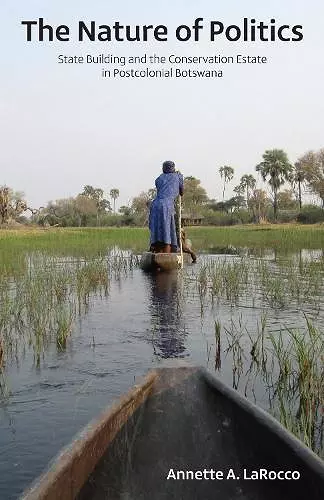
This case study of Botswana focuses on the state-building qualities of biodiversity conservation in southern Africa. Drawing on extensive fieldwork, Annette A. LaRocco argues that discourses and practices related to biodiversity conservation are essential to state building in the postcolonial era. These discourses and practices invoke the ways the state exerts authority over people, places, and resources; enacts and remakes territorial control; crafts notions of ideal citizenship and identity; and structures economic relationships at the local, national, and global levels.
The book’s key innovation is its conceptualization of the “conservation estate,” a term most often used as an apolitical descriptor denoting land set aside for the purpose of conservation. LaRocco argues that this description is inadequate and proposes a novel and much-needed alternative definition that is tied to its political elements. The components of conservation-control over land, policing of human behavior, and structuring of the authority that allows or disallows certain subjectivities-render conservation a political phenomenon that can be analyzed separately from considerations of “nature” or “wildlife.” In doing so, it addresses a gap in the scholarship of rural African politics, which focuses overwhelmingly on productive agrarian dynamics and often fails to recognize that land nonuse can be as politically significant and wide reaching as land use.
Botswana is an ideal empirical case study upon which to base these theoretical claims. With 39 percent of its land set aside for conservation, Botswana is home to large populations of wildlife, particularly charismatic megafauna, such as the largest herd of elephants on the continent. Utilizing more than two hundred interviews, participant observation, and document analysis, this book examines a series of conservation policies and their reception by people living on the conservation estate. These phenomena include securitized antipoaching enforcement, a national hunting ban (2014–19), restrictions on using wildlife products, forced evictions from conservation areas, limitations on mobility and freedom of movement, the political economy of Botswana’s wildlife tourism industry, and the conservation of globally important charismatic megafauna species.
With a smart research design and rich, original interviews, Annette A. LaRocco’s book complicates the existing narrative of Botswanan exceptionalism as she compares the politics for how and why the state builds roads in two different wildlife areas. Her work deftly bridges multiple disciplines, including political science, history, indigenous studies, development studies, and environmental policy, to investigate important real-world problems of conservation and public service delivery in Africa. - Lauren M. MacLean, Indiana University Bloomington Annette A. LaRocco’s well-written book advances our understanding of the intersection of biodiversity conservation and state politics. It is a welcome text for political ecological research and African studies. - Maano Ramutsindela, University of Cape Town A seminal and ground-breaking study . . . [that] will prove to be of particular value to readers with an interest in environmental science, policy, and African politics. (Midwest Book Review) As a political scientist who has sometimes been disappointed by the way the discipline has tended to think about environmental policy as just another issue area upon which institutions act rather than a politically co-constituted site, I find LaRocco’s work to construct and apply a more inclusive concept both encouraging and important. - Rachel DeMotts (International Journal of African Historical Studies) An outstanding, closely observed analysis of state and society in the context of conservation in Botswana. (H-Environment, H-Net Reviews) Annette A. LaRocco’s work is incredibly lucid, well articulated, and cogent-an essential and accessible resource for anyone interested in this field. - Baron Glanvill (African Studies Review)
ISBN: 9780896803343
Dimensions: unknown
Weight: unknown
408 pages