Theatre Closure and the Paradoxical Rise of English Renaissance Drama in the Civil Wars
Format:Paperback
Publisher:Cambridge University Press
Published:28th Aug '25
Currently unavailable, and unfortunately no date known when it will be back
This paperback is available in another edition too:
- Hardback£88.00(9781009224031)
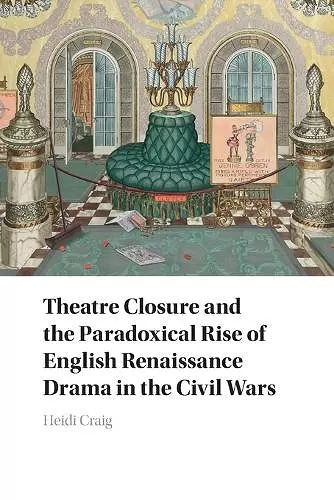
Heidi Craig demonstrates how dramatic and theatrical activity paradoxically thrived during the English theatre closures, 1642–1660.
For students and researchers of early modern drama, Shakespeare, book history and theatre history, this book unearths a wealth of dramatic activity during a period typically dismissed as a dramatic dead zone, showing how many scholarly practices can be traced back to the period itself.Focusing on the production and reception of drama during the theatre closures of 1642 to 1660, Heidi Craig shows how the 'death' of contemporary theatre in fact gave birth to English Renaissance drama as a critical field. While the prohibition on playing in many respects killed the English stage, drama thrived in print, with stationers publishing unprecedented numbers of previously unprinted professional plays, vaunting playbooks' ties to the receding theatrical past. Marketed in terms of novelty and nostalgia, plays unprinted before 1642 gained new life. Stationers also anatomized the whole corpus of English drama, printing the first anthologies and comprehensive catalogues of drama. Craig captures this crucial turning-point in English theatre history with chapters on royalist nostalgia, clandestine theatrical revivals, dramatic compendia, and the mysteriously small number of Shakespeare editions issued during the period, as well as a new incisive reading of Beaumont and Fletcher's A King and No King.
'Innovative in its adherence to subtle changes and continuations between the 1640s, 50s, 60s and 70s, Heidi Craig's brilliant study promises to reshape our thinking about early modern theatre history and the emergence of the field we now know as Renaissance drama. Drawing on detailed knowledge of book and theatre history, Craig illustrates how the apparent death of theatre in 1642, and the commercial practices of individual stationers, helped to shape both the posthumous histories of Shakespeare, Jonson and Beaumont and Fletcher, and ways in which drama was conceptualised in the late seventeenth century and beyond.' Emma Depledge, Université de Neuchâtel
'By focusing on the publication of drama during the closure of the theatres, Heidi Craig has given us a fascinating and original history of the English stage and its canonization as literature. With meticulous research but always written in a lively style, this book will be required reading for anyone interested in Early Modern English drama.' Zachary Lesser, University of Pennsylvania
'While [the book]'s chief intervention is to provide a long overdue account of and explanation for the rise in drama and dramatic criticism when theatres themselves were closed, its central contribution and core intellectual work is the collection and analysis of dramatic paratexts (ie, texts around texts). Each chapter makes extensive, sophisticated use of examples drawn from dedicatory epistles, commendatory poems, publisher's prefaces, and other threshold texts. This material serves as the foundation on which Craig tells the story of drama in the absence of theatre.' Jonathan P. Lamb, Early Theatre
ISBN: 9781009224055
Dimensions: unknown
Weight: unknown
255 pages