The Pashtun Borderland
A Religious and Cultural History of the Taliban
Format:Hardback
Publisher:Cambridge University Press
Published:19th Dec '24
Should be back in stock very soon
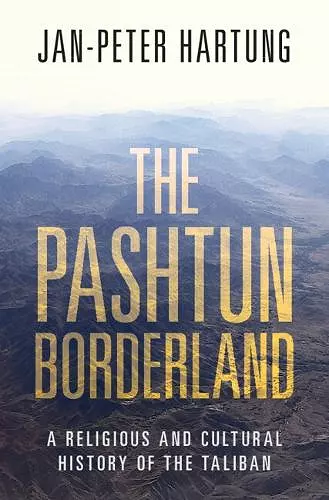
A timely investigation of the Taliban as a distinct cultural expression of the Pashtun Borderland of today's Afghanistan and Pakistan.
A history of the religious and socio-political developments in the Pashtun borderland of modern Afghanistan and Pakistan since the 17th century, and how these have informed the worldview of the various Taliban organizations of present times.Since the Taliban returned to power in Afghanistan in 2021, the need to understand the group's history and ideology has only increased. Jan-Peter Hartung's timely study examines the phenomenon of the Taliban through a topographically, ethnically and geo-politically distinct space: the Pashtun Borderland of today's Afghanistan and Pakistan. Emphasising the central role of Pashtun ethnicity, Hartung covers approximately five hundred years of Pashtun history: from the early modern Mughal empire to the first Durrani Empire in the eighteenth century and the regional developments during the colonial period in the nineteenth and early twentieth century. Drawing from a wealth of primary source materials in Pashto, Persian, Urdu and Arabic, Hartung moves the discussion of the Taliban beyond the immediacy of journalistic reportage and security-orientated studies, to a nuanced analysis of a wide range of actors and ideologies, refracting Afghanistan's present moment through the lens of its long cultural and religious history.
'This impressive volume makes multiple crucial interventions in the literature on Pashtuns. Hartung excavates vast reservoirs of local language sources for a longue durée social history that reframes the geographical context of cultural production using the borderscape concept while productively addressing class and other hierarchies in this polyvalent ideological space.' Shah Mahmoud Hanifi, James Madison University
'This is a deeply researched and illuminating history of the origins of the Taliban in the borderlands of contemporary Afghanistan and Pakistan. It is masterful in elucidating the processes that have shaped Islam and politics in this region and how they have come to be embodied in the phenomenon of the Taliban.' Muhammad Qasim Zaman, Princeton University
'While a vast body of scholarship has sought to unpack the intricate religious, social, and political dynamics of this borderland, Jan-Peter Hartung's book stands out as both original and seminal. In stark contrast to many authors who have relied primarily on colonial archives, standard references, and translated interviews, Hartung - fluent in Urdu, Persian, and Pashto - pursues a different path. On the one hand, he engages in meticulous archival research using local sources; on the other, hand, he complements this with anthropological fieldwork and interviews with numerous Islamic dignitaries. This combination yields a fresh and alternative understanding of Islamic resistance in the Pashtun borderland, one unfiltered by dominant (colonial) Western perspectives. These insights alone make the book a fascinating and, at times, breathtaking read. More than once, I found myself thinking that many of the U.S. military's mistakes during the intervention from 2002 to 2021 might have been avoided had this book been written three decades earlier – and made required reading for American military and political strategists.' Conrad Schetter, Asian Affairs
ISBN: 9781009289276
Dimensions: 235mm x 160mm x 36mm
Weight: 960g
592 pages