Rethinking Capital Punishment
The Pre-History of the Abolition of the Death Penalty
Format:Hardback
Publisher:Cambridge University Press
Published:2nd Apr '26
Should be back in stock very soon
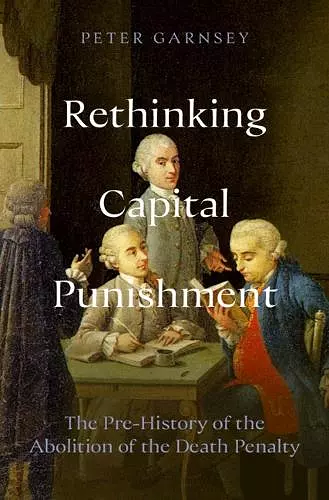
Until the 18th century, the death penalty was accepted universally. This study investigates the origins of the case for its abolition.
The death penalty was accepted almost universally until the 18th century, when Giuseppe Pelli of Florence and Cesare Beccaria of Milan produced works calling for its abolition. This study is the first to trace the origins of these ideas, from the Lex Talionis in the Code of Hammurabi to the emergence of utilitarianism in the late 18th century.The death penalty was accepted almost universally until the eighteenth century, when Giuseppe Pelli of Florence and Cesare Beccaria of Milan produced works calling for its abolition. Why was this form of punishment so integrated into laws and customary practices? And what is the pre-history of the arguments in favour of its abolition? This book is the first to trace the origins of these ideas, beginning with the Lex Talionis in the Code of Hammurabi and moving across the Bible, Plato, to the Renaissance, and the emergence of utilitarianism in the 18th century. It also explores how the advance of the abolition of the death penalty was held up for a time in Britain, and stalled, apparently permanently, in America. Peter Garnsey ranges across philosophy, theology, law, and politics to provide a balanced and accessible overview of the beliefs about crime and punishment that underlay the arguments of the first abolitionists. This study is a compelling and original contribution to the history of ideas about capital punishment.
'A riveting excavation of the ideas and arguments that shaped early critiques of capital punishment, ranging from the first discussions of retribution and deterrence to the eventual emergence of abolitionism. Garnsey maps a fractured, surprising genealogy that reshapes our understanding of how reformist thinking about punishment was forged. Erudite, gripping, indispensable.' Philippe Audegean, Sorbonne University
'The book provides a brilliant and learned discussion of legal punishment and the death penalty from antiquity to the abolitionism of the eighteenth century. Beginning with Plato's advocacy of punishment as reformative and following the legacy of humanism and utilitarianism the inquiry concentrates on C. Beccaria's celebrated critique of the death penalty, On Crimes and Punishments (1764). As an alternative to death he also proposed hard labour for public works: an idea debated in Britain and widely applied in the United States in the twentieth century and beyond.' Renato Pasta, University of Florence
'Garnsey's exceptionally wide-ranging erudition stretches from classical antiquity to the contemporary world, via medieval, early modern and Enlightenment jurists, theologians, philosophers and political thinkers. His incisive clarity of exposition and overall lightness of touch make for a fascinating account of what is still a hugely important subject.' Wilfrid Prest, The University of Adelaide
ISBN: 9781009760096
Dimensions: 229mm x 152mm x 13mm
Weight: 442g
202 pages