Muslim Capitalism
A Political and Legal History of Colonial Bombay
Format:Paperback
Publisher:Cambridge University Press
Publishing:30th Nov '26
£34.00
This title is due to be published on 30th November, and will be despatched as soon as possible.
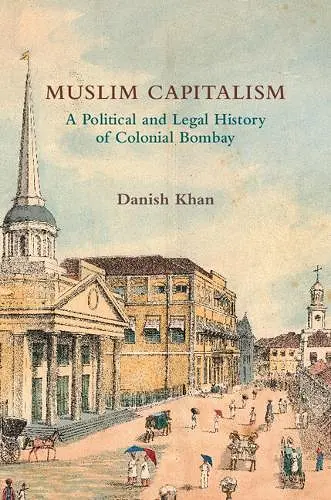
This title explores the lives of Muslim trading communities in colonial India for an interpretation of colonial economic life.
This book looks at Gujarati Muslim trading communities in colonial Bombay, challenging historiography by highlighting how local law, courts, and networks shaped daily business. It introduces a new framework to explore how colonial rule redefined religion and commerce through transformed property, inheritance, and waqfs administration.This book offers a history of Muslim capitalism in colonial India by examining Gujarati Muslim trading communities within the political economy of Bombay. Challenging a historiography dominated by global and transnational approaches, it shows how Muslim merchants were embedded in local institutions, legal regimes, and commercial networks of business. Through court records, legislative debates, commercial disputes, and family archives, it introduces the concept of the Muslim Divided Family as an alternative framework for understanding Muslim mercantile organization alongside the Hindu Undivided Family, and how colonial law transformed family property, waqf administration, inheritance, and religious authority, while revealing the uneven ways in which colonial governance accommodated different commercial communities. By placing Muslim merchants at the centre of debates on capitalism, law, and community, it offers a fresh interpretation of economic life in colonial South Asia and contributes to wider discussions on legal pluralism, corporate personality, and the relationship between religion and commerce.
'This book fills a gap that, for decades, surprisingly enough, has affected South Asian studies. It accounts for the specificity of the Bombay-based Muslim capitalists during the Raj from the points of view of their economic influence, legal ethos and political role. It relies on a variety of primary sources in an inter disciplinary perspective combining the methodology of the historians, lawyers, sociologists and political scientists.' Christophe Jaffrelot, King's College, London
'Danish Khan unravels the fascinating world of Gujarati Muslim merchants, in cosmopolitan Bombay. Tracing the entrepreneurial trajectories of the Bohras, Khojas and Memons, this book examines their transformation into influential business communities. Based on meticulous research and a systematic analysis of legal cases, it analyses how Muslim capitalists were defined and differentiated within the colonial legal framework. Despite facing structural disadvantages relative to Hindu trading groups, these communities nevertheless emerged as leading actors in a competitive commercial world. As the first major study of Muslim capitalism in South Asia, this book is an 'essential' for those interested in the rise of capitalism in South Asia and its legal, political and economic dimensions.' Medha Kudaisya, National University of Singapore
'In Muslim Capitalism, Danish Khan does what so many other historians have neglected to do: writing the story of Gujarati Muslims in Bombay who helped build up the world of Indian business. This book brings together business, legal, and political history to reorient scholarship on Indian Muslims away from North India and communal politics, helping us to understand the importance of Bombay Muslim capitalists as well as the unique limitations that they faced in capital formation.' Dinyar Patel, S. P. Jain Institute of Management and Research, Mumbai
'The diverse ways in which modern capitalism, law, and colonial states forged the identities of Muslim communities remains an urgent concern in the field of global history. In this brilliant book, Danish Khan delivers a compelling portrait of how these elements interacted within three Gujarati Muslim communities based in colonial Bombay. Empirically and analytically rich, Khan's study revels in the ambiguous ways in which the law alternatively sought to frame Muslims as a unified political body, while at the same time attenuating the consolidation of a class of Muslim capitalists that transcended differences of caste. Against earlier accounts that erroneously understood these groups through the normative templates of Islamic law or the Hindu Undivided Family, Khan delineates a new typology of the Muslim Divided Family, which combined elements of both while remaining distinct from them. The result is a stirring account that will be read widely by historians of Islam, colonialism, and legal pluralism.' Michael O'Sullivan, European University Institute, Fiesole
ISBN: 9781009787390
Dimensions: unknown
Weight: unknown
235 pages