Birgittine Acts of Memory
Remembering St Birgitta of Sweden
Format:Hardback
Publisher:Taylor & Francis Ltd
Publishing:22nd Dec '26
£171.99
This title is due to be published on 22nd December, and will be despatched as soon as possible.
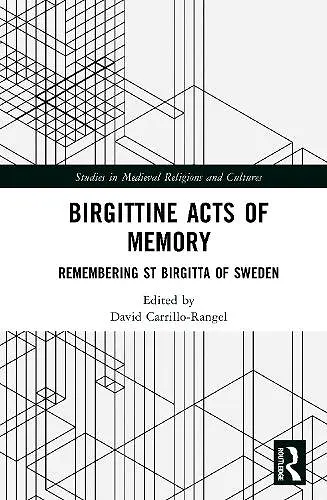
Birgittine Acts of Memory begins from a simple but insistent premise: memory is not something that is stored, but something that happens. Focusing on the Birgittine Order across late medieval Europe, modern Europe, and contemporary spaces, this volume explores how remembrance takes shape through gestures, materials, voices, and spaces. Moving beyond static notions of preservation, it approaches memory as an active, embodied, and relational process, entangled with questions of authority, devotion, and communal life, and unfolding across liturgy, objects, and affective practices.
Bringing together interdisciplinary contributions, this book moves across manuscripts, liturgical performance, visual culture, queer theory, and testamentary bequests, attending to the acts that sustain and transform memory. Birgittine communities emerge not as passive repositories but as dynamic sites where memory is continuously produced, negotiated, and reconfigured. What is at stake is not only what is remembered, but also how memory circulates, how it attaches itself to bodies and objects, and how it opens different temporalities within enclosed and public life. Memory, in this sense, is not merely retrospective but generative, shaping identities, communities, and devotional experience across time and space.
This volume will be of interest to scholars and students of medieval studies, religious history, memory studies, art history, and manuscript studies, as well as to readers engaged with material religion, monastic culture, and interdisciplinary approaches to the premodern archive.
‘Intellectual movements: if you are interested in history, this must-read book will draw you into, and out of it. It offers a kaleidoscope of figures, acts, identities, and it imagines potential hostesses for identification in a revolutionary spirit. To the first heading in the introduction: “A forest of theories” we can add “a forest of artworks” of different media, times, and styles, and “a forest of approaches”. The book presents acts of memory and/as transgression, in what the editor calls “a ruptural act of memory, as trans*gression, as movement across…”. Everything moves, which leads up to a new elaboration and definition of both the idea of history and of “queer”. The richness of this “queer” approach moves beyond any historical study and object I have ever read or seen. The central figure, Birgitta of Sweden, was and is religious, political, and her memory enforces the possibility of change. History is not fixable. Memory is material, affective and performative ; reaching outwards and bringing present and past together. Centred on one figure, this book revolutionizes history in the richest plurality I have ever encountered. Both “history” and “queer” are in a constant, profound, multi-tentacled drive' - Mieke Bal, Co-founder of the Amsterdam School for Cultural Analysis.
‘A superb collection of reflections and analyses of the histories of St. Birgitta of Sweden and her convents. By keeping consistent the saint and her convents, this book offers a very valuable cross-comparison not only of different approaches to the study of the same community or closely related ones, but of St. Birgitta and her legacy over time’ - Melissa M. Wilcox, University of California, Riverside.
'This imaginative collection of essays successfully combines different ways of remembering Birgitta whilst exploring, critiquing, and queering the act of memory itself. The reader is drawn into a multimodal arena of sounds, texts, and images, that invites engagement and contemplation. It is an essential and highly relevant book’ - Kate Maxwell, UiT The Arctic University of Norway.
ISBN: 9781032121079
Dimensions: unknown
Weight: unknown
272 pages