Urban Labyrinths
Informal Settlements, Architecture, and Social Change in Latin America
Pablo Meninato author Gregory Marinic author
Format:Hardback
Publisher:Taylor & Francis Ltd
Published:29th Mar '24
Currently unavailable, and unfortunately no date known when it will be back
This hardback is available in another edition too:
- Paperback£47.99(9781032532929)
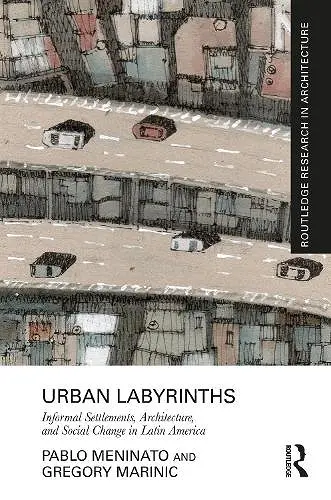
Urban Labyrinths: Informal Settlements, Architecture, and Social Change in Latin America examines intervention initiatives in informal settlements in Latin American cities as social, spatial, architectural, and cultural processes.
From the mid-20th century to the present, Latin America and other regions in the Global South have experienced a remarkable demographic trend, with millions of people moving from rural areas to cities in search of work, healthcare, and education. Without other options, these migrants have created self-built settlements mostly located on the periphery of large metropolitan areas. While the initial reaction of governments was to eliminate these communities, since the 1990s, several Latin American cities began to advance new urban intervention approaches for improving quality of life. This book examines informal settlement interventions in five Latin American cities: Rio de Janeiro, Medellín, São Paulo, Buenos Aires, and Tijuana. It explores the Favela-Bairro Program in Rio de Janeiro during the 1990s which sought to improve living conditions and infrastructure in favelas. It investigates projects propelled by Social Urbanism in Medellín at the beginning of the 2000s, aimed at revitalizing marginalized areas by creating a public transportation network, constructing civic buildings, and creating public spaces. Furthermore, the book examines the long-term initiatives led by SEHAB in São Paulo, which simultaneously addresses favela upgrading works, water pollution remediation strategies, and environmental stewardship. It discusses current intervention initiatives being developed in informal settlements in Buenos Aires and Tijuana, exploring the urban design strategies that address complex challenges faced by these communities. Taken together, the Latin American architects, planners, landscape architects, researchers, and stakeholders involved in these projects confirm that urbanism, architecture, and landscape design can produce positive urban and social transformations for the most underprivileged.
This book will be of interest to students, researchers, and professionals in planning, urbanism, architecture, urban design, landscape architecture, urban geography, public policy, as well as other spatial design disciplines.
"The authors demonstrate that collectively, the efforts of Latin American architects, planners, landscape architects, researchers, politicians, and communities involved in these projects prove that urbanism, architecture, and landscape design can foster positive urban and social transformations for the most disadvantaged communities. They call for the spatial disciplines to deepen their social responsibility and commit to contributing to improving the living conditions of these settlements ‘as a collaborative and ongoing endeavor.’
The book is well organized and written, engaging with its prose and graphic materials, a good complement to their previous edited book, ‘Informality and the City: Theories, Actions and Interventions’ (Marinic and Meninato Citation2022). It is valuable for students, researchers, and professionals in fields such as architecture, urban design, landscape architecture, planning, urban studies, urban geography, public policy, Latin American studies, history and other spatial design, social science, and humanities disciplines."
Clara Irazábal, Journal of Urban Design, published on July 5, 2025.
"The book’s main merit lies in redirecting the attention of architectural design professionals toward the theme of urban informality. The architects interviewed are part of a group of renowned professionals responsible for programs and projects to upgrade precarious settlements in which architectural projects for public buildings, squares and parks have been central to transforming the urban landscape."
Camila Saraiva, International Journal of Urban and Regional Research, published on July 4, 2025.
ISBN: 9781032504193
Dimensions: unknown
Weight: 480g
206 pages