Food History
Cultures of Food in the Modern World
Gabriele Proglio author Simone Cinotto author
Format:Paperback
Publisher:Taylor & Francis Ltd
Publishing:22nd Oct '26
£41.99
This title is due to be published on 22nd October, and will be despatched as soon as possible.
This paperback is available in another edition too:
- Hardback£155.00(9781032740379)
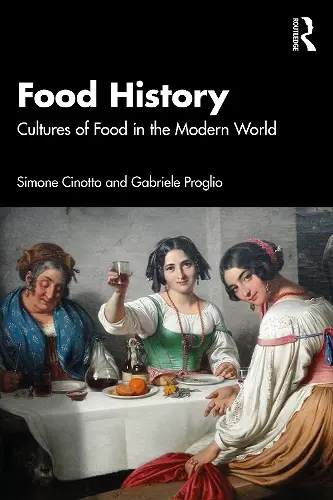
Food History: Cultures of Food in the Modern World analyzes the history of food as a dynamic, contextual process unfolding over time and space, diversified across the many food cultures and food systems of the world.
The book examines cuisines and tastes as historical formations, products of exchange and trade, shaped by the mobility of people, plants, and animals, as well as by the agricultural and culinary agency of farmers and cooks—most of them women—whose memory has often been lost in the margins of history. With its focus on the modern age, Food History describes the major transformations in the production, processing, distribution, and consumption of food that have shaped contemporary food systems and cultures. It traces the progressive globalization of food and the making of cuisines: from the birth of subsistence farming in the Fertile Crescent and the great agricultural civilizations of the ancient world, to the industrialization of food and the emergence of the nation-state and science as forces shaping the diets of large populations; from the “fast food” cuisine of global food multinationals to the “slow food” gastronomy that responded to such standardization, as well as the rise of food activism.
With its rich array of illustrations, maps, and case study boxes, Food History helps students and general readers understand food as a source of nourishment, health, pleasure, identity, and politics, as well as the impact that its production, distribution, and consumption have had on society and the environment.
“Insightful, comprehensive, and fascinating. The book is global in the best senses, showing the interconnectedness of food tastes as well as incorporating many countries into its description of modern innovations and food justice movements. The reader will find more than just an introduction to food history and culture but a sense of how we got here and the range of human appetites.”
Professor Paul Freedman, Yale University
From the origins of agriculture to contemporary global gastronomies, Cinotto and Proglio draw on exceptional scholarship to demonstrate the centrality of food. Compelling and thought-provoking, this book shows how food plays a major role not only in migration, war, state formation, and markets, but also culture, human development, and pleasure.
Professor Amy Bentley, New York University
“More than a history of food, this book uses food to illuminate history itself. Ranging across time and space, it connects eating to production, economy, politics, and cultural meaning, while integrating the field’s central debates. A rigorous yet accessible and compelling work.”
Professor Massimo Montanari, University of Bologna, Italy
“A smart, digestible, clearly written guide for anyone who has ever wondered why we eat the way we do. The authors dish up the perfect introductory text with examples from around the world to show students and curious readers alike that food is a crucial lens for understanding our complex past and imagining our shared future.”
Professor Michelle King, University of North Carolina Chapel Hill
“Food as a fait social total is masterly approached in this book that addresses the long-term world history of eating, with an emphasis on the modern period. It is essential for understanding the way we now eat and think about food.”
Professor Peter Scholliers, Vrije Universiteit Brussel, Belgium
“As a discipline, Food Studies has been disadvantaged by its lack of a true ‘home’ within the walls of the traditional university. The coherence, breadth, and depth of this text make it an invaluable critical companion; its delightful readability and admirably inclusive perspective make it feel like it could be the cornerstone we’ve been missing.”
Professor Danielle Callegari, Dartmouth College
ISBN: 9781032740355
Dimensions: unknown
Weight: unknown
248 pages