Elite Women in Early Modern Catholic Europe
Cinzia Recca editor Francisco Precioso Izquierdo editor
Format:Paperback
Publisher:Taylor & Francis Ltd
Published:19th Feb '25
Should be back in stock very soon
This paperback is available in another edition too:
- Hardback£171.99(9781032751702)
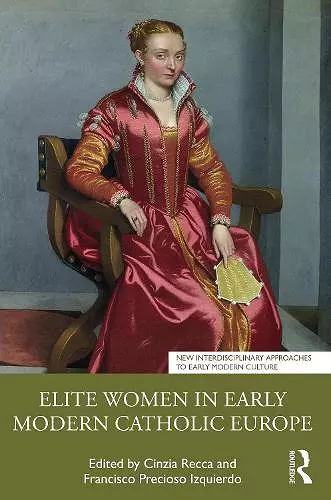
Elite Women in Early Modern Catholic Europe offers a new look at early modern Catholic Europe through the lens of the diverse experiences of elite women, using a historiographical approach to analyze women’s roles through changing political, social, and cultural contexts.
Through novel practices and broad social networks, distinguished women assumed prominent roles, from queens and princesses, to aristocrats and great nobles, to women of faith and religion. As the Counter-Reformation and the transition toward Enlightenment ideology swept France, Spain, and Italy, literacy and education became more accessible to upper-class women, who began to create new traditions in place of the old ways that were falling short. The case studies in this volume, ranging from the seventeenth to early nineteenth centuries, uncover the ways in which women were developing leadership skills and preserving status through participation in historical processes that affected real estate, the Church, and the social and family organization across Catholic Europe.
This book is an ideal resource for students and researchers studying early modern women and Catholic Europe.
This collection comprises 10 chapters by scholars outside the Anglophone world, focusing on the actions of elite women in the transformation and preservation of social structures in Catholic Western Europe, including Spain, Italy, and France, from the mid-16th to the mid-19th century. Princesses, queens and future queens, wealthy aristocrats, and other high-ranking women arranged matrimonial alliances, created new lineages and then wrote about them, established charitable associations that also funded luxuries for themselves, established familial and friendship networks that stretched across political boundaries, wrote wills that determined the destiny of family assets and letters that sought to determine this, and trained their daughters and other younger family members to continue in their footsteps. These were women born into power and wealth, so it is unsurprising that, as the editors note, “women’s action in the social, political, or religious world is usually aimed at maintaining the status quo” (p. 7). Still, the range of their actions is surprising, particularly for those who might still think of Catholic Europe as offering fewer opportunities for women’s agency, influence, and power than Protestant areas. Recommended. Graduate students and faculty.
M. E. Wiesner-Hanks, emerita, University of Wisconsin--Milwaukee CHOICE November 2025 Vol. 63 No. 3.
ISBN: 9781032751719
Dimensions: unknown
Weight: 340g
176 pages