Consociational Power-Sharing in Northern Ireland
Uncertain Stability
Rupert Taylor editor Timofey Agarin editor
Format:Hardback
Publisher:Taylor & Francis Ltd
Published:12th Sep '25
Currently unavailable, and unfortunately no date known when it will be back
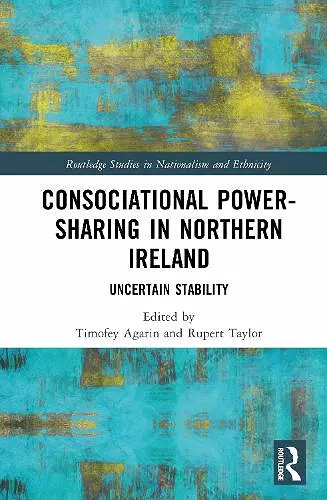
Consociational Power-Sharing in Northern Ireland, from leading scholars in the field, explores the evolution and challenges of consociational power-sharing in Northern Ireland for politics and societal relations.
Contributors to this book highlight that scholarship on consociational democracy anticipates political stability and continuous integration in post-conflict societies. However, over 25 years on from the Good Friday Agreement concerns remain about the adequacy of consociational power-sharing to ensure a fully functional form of government capable of providing stability and of addressing deeper political and social issues: While violence is absent, ethno-national identities remain in a state of a fragile equilibrium, and aspirations for significant progress on key issues like truth, justice, mutual respect, and socio-political inclusion have not been met. The reasons as to why this is so, and what can be done to rectify it, are central to the arguments that animate this timely book.
Consociational Power-Sharing in Northern Ireland will be of great interest to students and scholars in political science, law and constitutionalism, nationalism and ethnicity, and those interested in related topics in sociology and criminology. It will also appeal to practitioner communities related to power-sharing, political representation, and constitutional politics.
"This is a vital book on Northern Ireland’s consociational political arrangements. A collection of leading authors critically dissect the strengths and weaknesses of power-sharing between rival blocs. Although public support for the Good Friday Agreement remains strong, episodic collapses of the political institutions created by that 1998 deal have led to calls for reform. This volume analyses the value of power-sharing; explores the extent to which fragility is in-built within the polity; considers whether a consociation can ever degrade the bloc divisions it manages; and assesses how its democratic institutions might evolve. The book is an essential read for anyone wanting to better understand the difficult dynamics of managing a divided society."
Jonathan Tonge, Professor of Politics, University of Liverpool
"Northern Ireland’s peace was never meant to stand still. This urgent and unflinching collection reveals the cracks beneath the surface—fractured identities, stalled reforms, and politics in flux. With sharp contributions from leading voices including Brendan O’Leary, Matthijs Bogaards, Joseph Ruane, and Jennifer Todd, it asks the hard questions: what was promised, what was delivered, and what still lies ahead? Essential reading for anyone navigating the challenges of post-conflict consociational democracy."
Michael Kerr, Professor of Conflict Studies, King's College London
"This collection captures a moment at which the shine has come off consociationalism in Northern Ireland. These essays confront the challenges in applying consociational ideas in Northern Ireland amid the upheavals of Brexit and demographic shift, and the groups marginalised as a result. This makes for essential reading for anyone seeking to understand the process by which a society outgrows the strictures imposed by such a governance order and the challenges inherent in adapting such arrangements."
Colin Murray, Professor of Law and Democracy, Newcastle University
'Agarin and Taylor have assembled an impressive range of contributors to offer a comprehensive perspective on Northern Ireland’s consociational conundrum, which remains a paradigmatic case of ethnic conflict regulation. Individually and collectively, they explore what has and has not worked well since the original agreement in 1998. The intellectual depth of the analysis is outstanding, making this collection required reading for any student of the political dynamics of divided societies.'
Stefan Wolff, Professor of International Security, University of Birmingham
ISBN: 9781032864952
Dimensions: unknown
Weight: 634g
242 pages