Scandinavia in the Early Modern World
Terese Zachrisson editor Ale Pålsson editor
Format:Paperback
Publisher:Taylor & Francis Ltd
Publishing:29th Oct '26
£43.99
This title is due to be published on 29th October, and will be despatched as soon as possible.
This paperback is available in another edition too:
- Hardback£171.99(9781032938394)
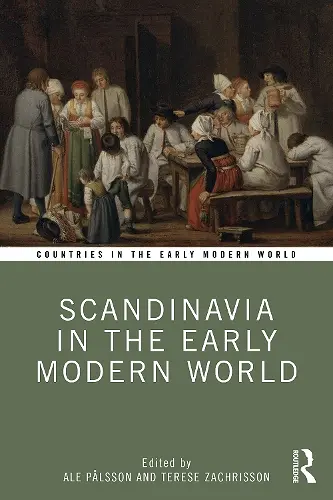
Scandinavia in the Early Modern World introduces the early modern history of the region, covering the period from the early sixteenth century to the end of the Napoleonic Wars in 1815. The volume places developments in Denmark, Norway, Sweden, Finland, Iceland and the Faroe Islands in relation to wider European and global historical contexts.
Rather than focusing exclusively on political elites and national narratives, the contributions examine political, social, economic, and cultural change across different regions and social groups. The book highlights both similarities and differences within Scandinavia, as well as tensions and conflicts that shaped the region over time. It includes discussions of Sápmi and of Scandinavian colonial involvement overseas, including activities in Greenland, West Africa, the Americas and India, and situates these within broader patterns of trade and empire in the early modern world. By adopting a broad regional perspective, the volume illustrates how early modern state formation and social change took different forms across Scandinavia.
This book is a valuable resource for students, scholars, and general readers interested in early modern Nordic history, political and socio-economic history, imperial history, global history, and the history of trade.
Scandinavia in the Early Modern World ambitiously presents Scandinavia c. 1500–1800 both globally and locally to an international audience. It provides an alternative story beyond the kings and nation-states. It explores how the religious-magic universe shaped people’s minds, and how the underprivileged and marginal groups – women, peasants, ethnic minorities, and the landless poor – lived and managed despite injustice from above. It highlights the harsh Nordic climate where communities permanently were living on the brink of starvation, and how Scandinavian colonialism in Africa, Latin-America and Asia – especially the slavery – changed the self-image in the North.
- Knut Dørum, University of Agder
An immense amount of fascinating detail is crammed into this rich overview of one of the less famous periods of Scandinavian history -- less so, that is, than those (vikings! hygge!) on either side of the years covered in this book, from roughly 1520 to 1815. This new history of early modern Scandinavia is firmly grounded in the physical and political geography of the Nordic region, which it compasses with admirable breadth to include Finland, the Baltics, and Pomerania. The volume's interest in the historical experiences of the landless poor, Sámi people (the subject of a separate chapter), and Scandinavia's colonial subjects drives some of its most memorable insights, for example into the prospects of servants across Scandinavia, or changing patterns of subsistence in Sápmi. It throws much light on historiographic questions such as the nature of Scandinavian colonialisms and their difference from other European imperial projects. Traditional topics such as the military, the Lutheran church, and the universities offer incisive historical surveys, telling examples that stick in the mind, and judicious and up to date recommendations for further reading. Not only the students whom the editors propose as readers, but just about anyone who takes this book in hand will learn something new and emerge from it with a wish to know more.
- Kate Heslop, University of California
Scandinavia in the Early Modern World offers an excellent introduction to Nordic history. The book covers in-depth overviews of current academic issues, from state formation and social control to the colonial exploitation of the lands of the Sami. It brings together scholars from four countries and firmly places Scandinavia in the global context. It is highly recommended for students as well as the historically interested public.
- Mats Hallenberg, Stockholm University
ISBN: 9781032946870
Dimensions: unknown
Weight: unknown
280 pages