Lacan for Criminologists
Zemiology, Ultra-Realism, and Harm Reduction
Rafe McGregor author David Grčki author Ema Lalić author
Format:Paperback
Publisher:Taylor & Francis Ltd
Publishing:3rd Aug '26
£41.99
This title is due to be published on 3rd August, and will be despatched as soon as possible.
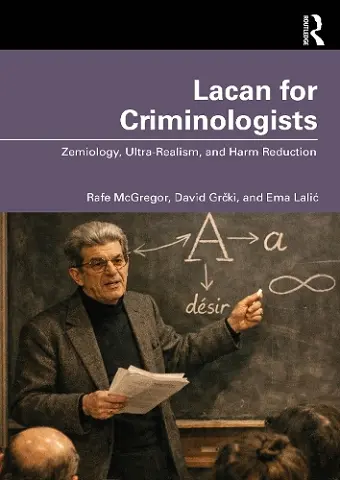
This book provides a clear and concise introduction to the work of French cultural icon Jacques Lacan (1901–1981) for criminologists, sociologists, and social theorists. The authors approach Lacan as a structuralist rather than a psychoanalyst or psychiatrist, exploring his perspective on the relationships among being, agency, meaning, and structure; his construction of subjectivity; and his register theory, constituted by the Real, the Imaginary, and the Symbolic.
The book begins with an analysis and evaluation of the only substantive criminological deployment of Lacan’s philosophy to date, in the ultra-realist framework developed by Steve Hall, Simon Winlow, and Thomas Raymen. The strengths of this framework suggest that Lacan’s work has even more relevance to crime and harm in the digital age than it did in the 20th century. Lacan for Criminologists picks up where ultra-realism leaves off, engaging directly with Lacan’s Écrits and seminars to demonstrate their value to a critical criminology that is theory-led, evidence-based, and zemiologically-focused.
This book will be fascinating reading for cultural, critical, and ultra-realist criminologists, as well as students and scholars of sociology, cultural studies, and social theory.
The first thorough examination of ultra-realist theory in a Lacanian context. The points of convergence and dispute identified here are further steps towards the sophisticated zemiological framework criminology needs to move forward in the twenty-first century.
Steve Hall, Professor Emeritus, Teesside University
The ubiquity of abstract empiricism and the drab emotivism of so much contemporary theorising mean criminology has little of note to say about the world today. Where can we look to discover the energy and insight we need to drag criminology out of its self-satisfied inertia? The work of Jacques Lacan is an excellent place to start. In this well-written and insightful book, the authors offer criminologists a rigorous but accessible introduction to Lacan’s oeuvre, outlining his central concepts and encourage us to use Lacan to deepen our understanding of crime and harm.
An excellent introduction to Lacan. A must-read for all true criminologists!
Simon Winlow, Professor, Northumbria University
Since its inception, many outside the Ultra Realist project have engaged in a critical manner. Often such engagement has been disingenuous, erroneous or dismissive. In this thesis the authors state the value of the Ultra Realist framework is, in part, its success in bringing forth a much-needed theoretical revolution in Criminology. Equally, the value of this book is propelling the revolution forth through rigorous, stimulating and intellectual debate. A brilliant contribution highlight the necessity of a Lacanian Zemiology.
Craig Kelly, Senior Lecturer in Criminology, Birmingham City University
Lacan for Criminologists is essential reading for anybody who wants to understand the relationship between the normal violence of late capitalism, individual psychology endlessly in search of some sense of relief, and crime and deviance in liberal democratic society. McGregor, Grčki, and Lalić expertly reveal the Lacanian psychology underpinning Hall and Winlow’s criminogenic society and in this regard suggest pathways to the reduction of harm for a neo-Hobbesian model of society that seems to survive in a dire state balanced on the edge of chaos
Mark Featherstone, Professor of Sociology, Keele University
ISBN: 9781032975146
Dimensions: unknown
Weight: unknown
90 pages