The Holodomor in Politics, Memory and History
Cognitive, Interpretive and Explanatory Challenges
Format:Hardback
Publisher:Taylor & Francis Ltd
Published:17th Nov '25
Should be back in stock very soon
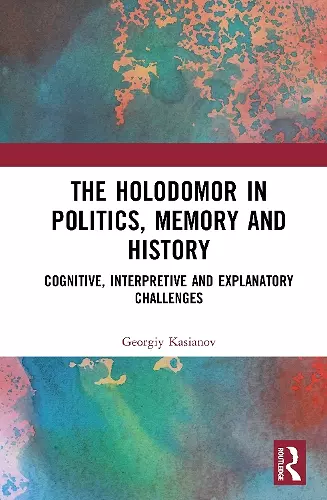
This volume presents the first comprehensive scholarly analysis of the collective memory of the Holodomor—the Ukrainian Great Famine of 1932-1933—examining its construction, evolution, and contestation across nearly a century. Moving beyond historical accounts of the event itself, this book interrogates how memories of this catastrophe have been shaped, mobilized, and interpreted within multiple discursive frameworks.
Drawing on interdisciplinary methodological approaches from memory studies and political science, the author provides a rigorous examination of how the Holodomor has been constructed as social (cultural) memory by actors who challenged Soviet policies of enforced amnesia. This book illuminates the complex interrelationship between memory agents, political institutions, and commemorative practices while critically assessing the securitization of memory and its implications for academic discourse.
This theoretically nuanced contribution to memory studies and Eastern European historiography will be indispensable for researchers and postgraduate students engaged with genocide studies, collective memory, post-Soviet politics, and the intersection of historical narrative and national identity formation.
“As both a scholar and an active participant in the debates over memory politics in Ukraine, Georgiy Kasianov offers a unique perspective on the formation of historical narratives and memory regimes in post-communist Eastern Europe. Through his examination of the debates, policies, and commemorative practices surrounding the Holodomor—the man-made famine of 1932–1933 that claimed millions of lives—he illuminates the complex interplay between history, national identity, and memory in a key European country once again fighting for its existence.”
- Serhii Plokhii, Mykhailo S. Hrushevsky Professor, Department of History, Harvard University
“Georgiy Kasianov explains how the interpretations of the Ukraine Famine 1932-33 (Holodomor) have fallen victim to both historical politics and political disputes between Ukraine and Russia. He provides an exhaustive chronicle of the investigations into and historiography of the Famine over a period of more than four decades. The book is particularly notable for the author’s honest and detached approach in demonstrating how a tragedy that is regarded as the defining event of modern Ukrainian identity has been exploited for political purposes.”
- David R. Marples, University of Alberta Distinguished Professor, Canada
“Well-researched, erudite and thorough, Kasianov’s study analyzes the rise of the Holodomor discourse, from its beginnings among Ukrainian diaspora in North America, towards its repatriation in Ukraine, and finally to its canonization as a cornerstone of post-Soviet Ukrainian mythology following the 2004-2005 Orange Revolution. Kasianov’s tour de force is essential reading for anyone interested in memory politics in post-Soviet Ukraine.”
- Per A. Rudling, Associate Professor, Wallenberg Academy Fellow, Department of History, Lund University
ISBN: 9781041135029
Dimensions: unknown
Weight: 570g
210 pages