Displaced Persons and the Reshaping of American Immigration after World War II
Refuge Denied and Refuge Provided
Format:Paperback
Publisher:Taylor & Francis Ltd
Publishing:14th Sep '26
£41.99
This title is due to be published on 14th September, and will be despatched as soon as possible.
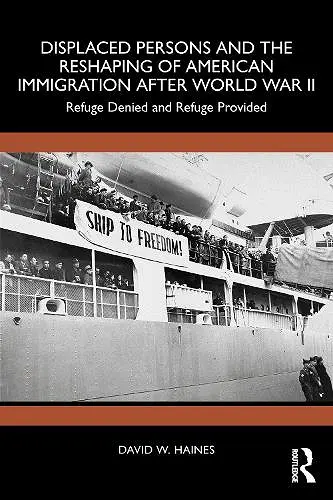
Displaced Persons and the Reshaping of American Immigration after World War IItraces the journey of U.S. policy toward displaced persons (DPs) in post-war Europe, examining how America transformed from a nation resistant to accepting refugees to one that ultimately created a groundbreaking resettlement program.
Despite initial public apathy and political resistance, America eventually welcomed roughly 400,000 refugees through a nationwide program, reopening the gates of U.S. immigration that had been largely shuttered since the 1920s. This book meticulously examines the factors that drove this remarkable shift: the persistent advocacy of humanitarian champions, the recognition of DPs' potential contributions as workers and community members, and crucially, President Harry Truman's leadership and commitment to human dignity. Through an exploration of legislative battles, implementation challenges, and varying state and local responses, the narrative reveals how America's refugee policy was shaped by competing interests and perspectives. The author provides a balanced understanding of how public policy evolves through denial, delay, and eventual action. It is an instructive story of the makings, workings, and effects of American public policy and one that provides lessons for the advances and reversals of U.S. efforts on behalf of refugees in more recent years.
Essential reading for students of American history, immigration policy, and humanitarian affairs, this book offers valuable insights into the historical precedents of today's refugee debates and the complex interplay between American ideals and practices.
“A fascinating and readable book on how the U.S., in a time of highly restrictive immigration policies, opened its doors to several hundred thousand displaced persons from Europe after World War II. In analyzing the complex interplay of factors involved, Haines raises important questions of relevance to refugee debates in America today.”
Nancy Foner, Distinguished Professor Emerita of Sociology, Hunter College and Graduate Center, City University of New York
“Haines offers us a rich, original, and deeply researched analysis of the history of America’s treatment of displaced persons in the aftermath of World War II. There is much to learn in the story Haines tells of the gradual evolution from denial, through delay, to resettlement. Understanding this legacy is of particular importance in the current moment as we consider our humanitarian obligations to those displaced by famine, violence, or persecution.”
Caroline B. Brettell, Distinguished Professor of Anthropology Emerita, Southern Methodist University
“David Haines’s new book on the creation of the Displaced Persons Act provides a nuanced overview of the forces impacting 20th century U.S. refugee policy, particularly the tensions between those who envisioned America as a place of refuge and those who sought to delay action on refugee issues. It will be a crucial text for students and scholars alike in the field.”
Kristen Anderson, Professor of History, Webster University
ISBN: 9781041234388
Dimensions: unknown
Weight: unknown
298 pages