China’s Digitalization of Public Diplomacy
Navigating Panda and Wolf Warrior Styles
Format:Hardback
Publisher:Taylor & Francis Ltd
Publishing:30th Nov '26
£171.99
This title is due to be published on 30th November, and will be despatched as soon as possible.
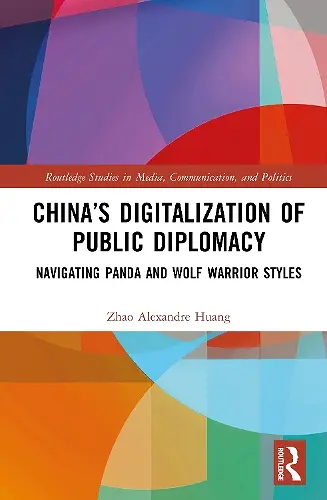
This book investigates the digital transformation of China's public diplomacy, focusing on how the Chinese government has adapted and redefined this practice within its own political and ideological framework.
Drawing on communicative constructivism, it conceptualizes the digitalization of public diplomacy as an organized process of meaning construction through which political identities, international norms, and discourse power are produced and contested. The analysis traces historical continuities from propaganda, people-to-people diplomacy, and symbolic solidarity to contemporary forms of platformized communication based on strategic narratives shaped by China’s party-state institutions. Empirical case studies address panda diplomacy, COVID-19 communication in Africa, narratives surrounding the Russia–Ukraine war, and diaspora engagement through WeChat. The book argues that this system follows a realist-constructivist logic, combining regime security and geopolitical interests with efforts to reorganize discursive environments and build a communication order aligned with the ideological priorities of the Communist Party of China.
This timely study will interest scholars and graduate students of international relations and communication science, public diplomacy studies, international/intercultural communication, and critical communication studies, as well as political science, organizational communication, and social theory.
“Zhao Alexandre Huang follows China’s digital public diplomacy across its full variety of voices, from the panda to the wolf warrior, and arrives at a finding that contests a central assumption about digital diplomacy. Digital platforms were expected to make diplomacy more transparent, open, and participatory. Huang demonstrates how, in the Chinese context, they can produce the opposite effect. Drawing on a purpose-built corpus of more than a million tweets from 301 Chinese accounts, plus Weibo and WeChat material, he examines four cases: panda imagery on state media accounts, the COVID-19 campaign aimed at African publics, war framing across Weibo and X, and diaspora outreach on WeChat in France. He reveals how state actors can use social media to conceal central coordination rather than encourage authentic dialogue.
At the heart of the book is Huang’s compelling concept of the “illusion of polyphony”: diplomats, state media, embassies, and diaspora publishers differ in tone yet are aligned in political orientation, producing what Huang calls “polyphonic artifacts” — the appearance of multiple voices while reproducing a remarkably coherent line. The evidence is granular and surprising. Panda content grew more emotional and less overtly political between 2017 and 2020, illustrating strategic adaptation rather than retreat. On Ukraine, Chinese accounts spoke through third parties nearly five times more often abroad than at home.
Methodologically, Huang demonstrates the potential of computational approaches for public diplomacy research, showing how a fine-tuned language model can extend qualitative coding to corpora no team could read by hand, while retaining human validation and interpretive oversight. Conceptually ambitious, empirically rich, and methodologically innovative, this is essential reading for anyone working on public diplomacy, strategic communication, or global information politics.”
-- Diana Ingenhoff, Professor of Strategic Communication and Public Diplomacy, University of Fribourg, Switzerland
“The book we have been missing to understand China’s digital public diplomacy. Huang offers compelling case studies on how political authoritarianism combines with digital tools to shape global perceptions. An insightful reading for scholars and students of international relations, communication, China studies, and digital diplomacy”.
-- Christian Lequesne, Professor of International Relations, Sciences Po University, France
“In this book, Huang offers scholars and students a much-needed framework for understanding the practice of digital diplomacy in authoritarian regimes. Combining an innovative theoretical approach, highly relevant case studies and unique insight, Huang has authored a must-read book for all digital diplomacy scholars. This is a serious and important book - a landmark in digital diplomacy studies.”
-- Ilan Manor, Professor of Communication, Digital Diplomacy Scholar, Ben Gurion University of the Negev, Israel
“Zhao Alexandre Huang has produced a thoughtful and original contribution to the study of digital diplomacy and China’s international communication. Combining theoretical sophistication with rich empirical research, this book offers a compelling analysis of how digital platforms have transformed China’s public diplomacy and the projection of its global narratives. Engaging, methodologically rigorous, and conceptually innovative, it will be essential reading not only for scholars and students of public diplomacy, but also readers seeking to understand the role of digital media in China’s international relations and foreign policy.”
-- Gary D. Rawnsley, Professor of Public Diplomacy, University of Lincoln, UK
“China’s Digitalization of Public Diplomacy by Zhao Alexandre Huang is a monumental piece of research — breathtaking in its scope and depth. While Chinese public diplomacy has garnered much attention, most studies echo a simplistic, Cold War-era model of authoritarian propaganda. Huang breaks the mold by introducing a nuanced, multi-layered analysis and original empirical research to demonstrate the evolution of China’s growing sophistication in harnessing the technical affordances of the digital ecosystem to create, diffuse and monitor carefully calibrated narratives. He draws on interdisciplinary theories to introduce novel conceptual frameworks, grounding his analysis in four cases – panda diplomacy on Twitter/X, China’s COVID-19 engagement with African publics, the Russia-Ukraine conflict, and WeChat-based Chinese diaspora diplomacy – using computational research, network analysis, and sentiment analysis. His linguistic and cultural fluency lucidly reveals symbolic and emotional significance. The book challenges the popular assumption that digitalization democratizes public diplomacy, showing instead a contest-rich arena where diverse actors weave fragmented content into networks of strategic relational, discursive and performative influence – with implications extending well beyond China's own practices.”
-- Rhonda S. Zaharna, Professor Emerita of Public Communication, American University, USA
"Insightful, persuasive and deeply researched, Professor Huang’s pioneering study makes a major contribution to the field of public diplomacy and its increasing digitization, as witnessed in the case of China. Highly recommended."
-- Daya Thussu, President of IAMCR; Professor and Senior Research Fellow, University of London, UK
ISBN: 9781041424031
Dimensions: unknown
Weight: unknown
262 pages