Nation and Loyalty in a German-Polish Borderland
Upper Silesia, 1848–1960
Format:Hardback
Publisher:Cambridge University Press
Published:4th Oct '18
Currently unavailable, and unfortunately no date known when it will be back
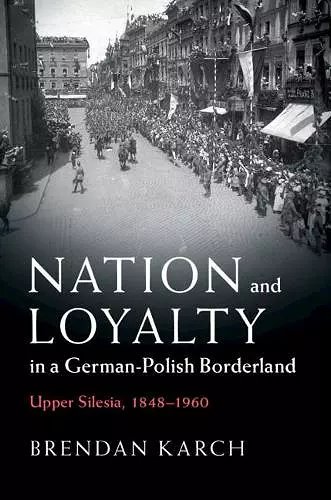
A century-long struggle to make a borderland population into loyal Germans or Poles drove nationalist activists to radical measures.
In the borderland of Upper Silesia between 1848 and 1960, the local population resisted attempts by nationalist activists to compel them to become loyal Germans or Poles, a divide dictated by the two languages they spoke. This study of that resistance will appeal to scholars of European history and nationalism.In the bloody twentieth-century battles over Central Europe's borderlands, Upper Silesians stand out for resisting pressure to become loyal Germans or Poles. This work traces nationalist activists' efforts to divide Upper Silesian communities, which were bound by their Catholic faith and bilingualism, into two 'imagined' nations. These efforts, which ranged from the 1848 Revolution to the aftermath of the Second World War, are charted by Brendan Karch through the local newspapers, youth and leisure groups, neighborhood parades, priestly sermons, and electoral outcomes. As locals weathered increasing political turmoil and violence in the German-Polish contest over their homeland, many crafted a national ambiguity that allowed them to pass as members of either nation. In prioritizing family, homeland, village, class, or other social ties above national belonging, a majority of Upper Silesians adopted an instrumental stance towards nationalism. The result was a feedback loop between national radicalism and national skepticism.
'Nations have powers to tax, make war, and demand ultimate loyalty, but for much of history, Upper Silesians' local identity - their particular language, religiosity, and patterns of daily life - was not only more important than nationhood: it was more real. By appropriating aspects of German and Polish nationality for their own purposes, Upper Silesian villagers and town folk made the German and Polish nations serve them and their needs, rather than the other way around. In his humane, absorbing, and restlessly curious narrative, Karch brings this people's complex and fascinating story to life, making an indelible and vital contribution to our understanding of nationalism.' John Connelly, University of California, Berkeley
'Brendan Karch's masterful and provocative study reveals how ordinary Upper Silesians and local leaders hijacked competing nationalisms for their own ends. Rather than sharpening divisions, a century of German-Polish conflict in the region led to individual choices that 'de-privileged' loyalty to any one nation. Meticulously documented and elegantly structured, the book comes to surprising and challenging conclusions on ethnic mobilization and 'national indifference.' Winson Chu, University of Wisconsin,Milwaukee and author of The German Minority in Interwar Poland
'This is an important contribution … Karch's study is a story of prolonged and largely successful local resistance to national projects … it suggests a full alternative account of nationalism-as-failure rather than nationalism-as-end-stage-of-human-development, in which nationalism generates the contradictions that lead to its own demise … a wonderful addition to scholarship on Upper Silesia as well as on nationalism and nationalization more broadly.' James Bjork, King's College London
'This is a rich and conceptually rigorous study that exposes many of the shortcomings of the thinking of national activists and academics alike who have accepted the flattening, all-encompassing nature of the category of national identity.' Brendan Karch, EuropeNow
'Karch's work, rewardingly steeped in German and Polish archival material and secondary literature, is an important addition to this growing store of knowledge and entailed methodological insights, because - uniquely, in Anglophone literature - it focuses on interwar Germany's section of Upper Silesia.' Tomasz Kamusella, European History Quarterly
'It is a refreshing and entertaining read and substantially contributes to current discussions on nationalities and ethnically mixed borderlands.' Jochen Böhler, Journal of Modern History
ISBN: 9781108487108
Dimensions: 235mm x 160mm x 20mm
Weight: 690g
346 pages