Our Time is Now
Race and Modernity in Postcolonial Guatemala
Format:Paperback
Publisher:Cambridge University Press
Published:14th Apr '22
Currently unavailable, and unfortunately no date known when it will be back
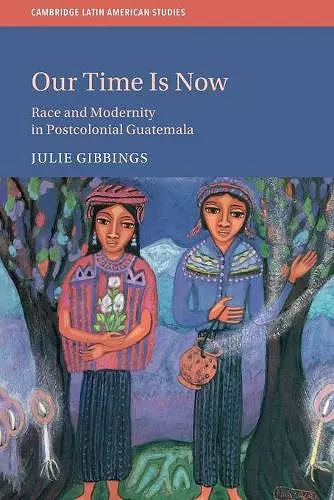
An illustration of how indigenous and non-indigenous actors deployed concepts of time in their conflicts over race and modernity in postcolonial Guatemala.
Merging the histories of capitalism with political and cultural analysis, Gibbings demonstrates how the struggle between indigenous people and settlers to manage contested ideas of modern politics, economics, and social norms was central to the rise of coffee capitalism in Guatemala and to twentieth century populist dictatorship and revolution.Postcolonial histories have long emphasized the darker side of narratives of historical progress, especially their role in underwriting global and racial hierarchies. Concepts like primitiveness, backwardness, and underdevelopment not only racialized and gendered peoples and regions, but also ranked them on a seemingly naturalized timeline - their 'present' is our 'past' - and reframed the politics of capitalist expansion and colonization as an orderly, natural process of evolution towards modernity. Our Time is Now reveals that modernity particularly appealed to those excluded from power, precisely because of its aspirational and future orientation. In the process, marginalized peoples creatively imagined diverse political futures that redefined the racialized and temporal terms of modernity. Employing a critical reading of a wide variety of previously untapped sources, Julie Gibbings demonstrates how the struggle between indigenous people and settlers to manage contested ideas of time and history as well as practices of modern politics, economics, and social norms were central to the rise of coffee capitalism in Guatemala and to twentieth century populist dictatorship and revolution.
'It is hard to write a modern Guatemalan history that is a not just a grim march to the genocide of the 1980s, but this exciting, meticulous book does it spellbindingly. Refusing to universalize colonizing linear time, Gibbings pries open the archive to engage the pluriverse of transforming Mayan experience with salutary attention to gender. While rooted lovingly in place, this is a profound analysis of plantationocene worlding that will resonate for anyone concerned with today's global crisis of racialized climate collapse.' Diane Nelson, author of Who Counts? The Mathematics of Death and Life After Genocide
'Through nuanced analysis of archival materials and oral histories, Gibbings reveals indigenous peoples' perspectives, strategies, and responses to local and national politics. In so doing, she captures the complexity of class, gender, ethnic, and power relationships amongst Q'eqchi Mayas and between them and Hispanic authorities.' David Carey, author of I Ask for Justice: Maya Women, Dictators, and Crime in Guatemala, 1898-1944
'Gibbings deftly renders the radical imaginaries of indigenous Guatemalans, for whom the legacies of empire, liberalism, forced labor, and political violence weighed like a nightmare. This theoretically sophisticated and archivally-grounded book not only recasts the history of post-colonial Guatemala but also, like the very Q'eqchi Maya alternative modernities at the heart of its story, unsettles the normative temporalities and teleologies of Western racial capitalism.' Kirsten Weld, author of Paper Cadavers: The Archives of Dictatorship in Guatemala
'Packed with insights, this work is essential reading for all Guatemalanists and specialists interested in Native intermediaries, rural land and labor systems, and subaltern histories of the transition to capitalism.' J. T. Way, Hispanic American Historical Review
'Our Time Is Now is an extensive, carefully researched and elegantly argued book that presents its readers with multiple, intertwined histories: of the development of coffee production and the nation-state in Guatemala's majority Indigenous Alta Verapaz region; of the concurrent emergence of key ideas about race, progress and 'modernity' in Guatemala as a whole; and also, more reflexively and, as its title suggests, about the often-contentious ways in which history is created, and how such processes may be tied to contested definitions of time itself.' Nathaniel Morris, Journal of Latin American Studies
'Theoretically profound, painstakingly researched, thoughtfully argued and beautifully written, Julie Gibbings' Our Time Is Now is a brilliant addition not only to Guatemalan and Latin American history but to colonial and postcolonial studies in general.' Michael D. Kirkpatrick, Canadian Journal of Latin American and Caribbean Studies
'… a fascinating history … meticulously researched … this book has much to offer both historians of Guatemala and people interested in historical methodologies.' Catherine A. Nolan-Ferrell
ISBN: 9781108733489
Dimensions: 227mm x 151mm x 26mm
Weight: 590g
428 pages