Remaking Ukraine after World War II
The Clash of Local and Central Soviet Power
Format:Hardback
Publisher:Cambridge University Press
Published:21st Jan '21
Currently unavailable, and unfortunately no date known when it will be back
This hardback is available in another edition too:
- Paperback£25.99(9781108794183)
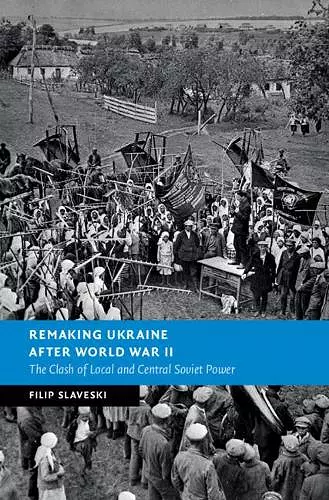
Examines Soviet Ukraine's long transition from war to 'peace' after World War II, and the bitter struggle for land, food and power.
Drawing on recently declassified Soviet sources, this examines Soviet Ukraine's transition from war to 'peace' in the long aftermath of World War II, exploring the battle for land, resources and power among collective farmers, local and central Soviet authorities in reconstructing post-war Ukraine. The consequences of this battle resonate today.Ukraine was liberated from German wartime occupation by 1944 but remained prisoner to its consequences for much longer. This study examines Soviet Ukraine's transition from war to 'peace' in the long aftermath of World War II. Filip Slaveski explores the challenges faced by local Soviet authorities in reconstructing central Ukraine, including feeding rapidly growing populations in post-war famine. Drawing on recently declassified Soviet sources, Filip Slaveski traces the previously unknown bitter struggle for land, food and power among collective farmers at the bottom of the Soviet social ladder, local and central authorities. He reveals how local authorities challenged central ones for these resources in pursuit of their own vision of rebuilding central Ukraine, undermining the Stalinist policies they were supposed to implement and forsaking the farmers in the process. In so doing, Slaveski demonstrates how the consequences of this battle shaped post-war reconstruction, and continue to resonate in contemporary Ukraine, especially with the ordinary people caught in the middle.
'Slaveski's monograph … provides a fascinating insight into relations between Ukrainian collective farmers and the different layers of the Soviet state, and how these intertwined with clashes between local, republican and central officials. Slaveski ably underlines the difficulty the centre faced in having to rely upon local officials, who had their own interests and networks, to implement its policies.' Christopher Gilley, Europe-Asia Studies
ISBN: 9781108840255
Dimensions: 235mm x 157mm x 18mm
Weight: 480g
224 pages