Rome Enters the Greek East
From Anarchy to Hierarchy in the Hellenistic Mediterranean, 230-170 BC
Format:Paperback
Publisher:John Wiley and Sons Ltd
Published:9th Feb '12
Currently unavailable, and unfortunately no date known when it will be back
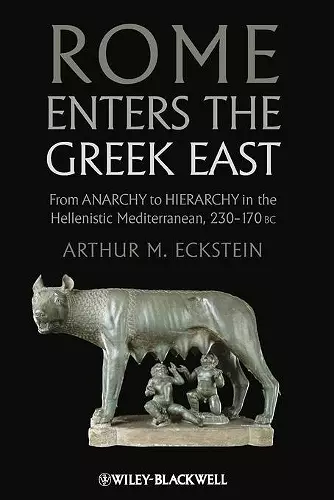
This volume examines the period from Rome's earliest involvement in the eastern Mediterranean to the establishment of Roman geopolitical dominance over all the Greek states from the Adriatic Sea to Syria by the 180s BC.
- Applies modern political theory to ancient Mediterranean history, taking a Realist approach to its analysis of Roman involvement in the Greek Mediterranean
- Focuses on the harsh nature of interactions among states under conditions of anarchy while examining the conduct of both Rome and Greek states during the period, and focuses on what the concepts of modern political science can tell us about ancient international relations
- Includes detailed discussion of the crisis that convulsed the Greek world in the last decade of the third century BC
- Provides a balanced portrait of Roman militarism and imperialism in the Hellenistic world
"A strength of Eckstein’s volume is the balance of international relations theory with the detailed history of the transformation of the Hellenistic multipolar anarchy from the First Illyrian War to the period of Roman “unipolarity”. This consolidates the placement of political theory within current historiography of the interstate relations of the mid- Republic and Hellenistic world. Based on the reception of IR Realism in the various studies cited here which have engaged directly or peripherally with Eckstein’s volume, there are two major ideas for which he argues that are already working their way through the ancient historical consciousness: that fear, threat, force and violence underpin interstate discourses and were commonplace in the experiences and strategies of both primary and secondary polities; and that all polities were stakeholders in international relations, with neither Roman (or others’) ambivalence preventing their participation, nor secondary states’ comparative weakness limiting their determination to join the negotiation of conflict. We shall in future see much more scholarship based upon these two central arguments." (Bryn Mawr Classical Review, 7 May 2013)
ISBN: 9781118255360
Dimensions: 230mm x 154mm x 21mm
Weight: 581g
456 pages