Gramsci and the Struggle for Democratic Communism
Format:Hardback
Publisher:Bloomsbury Publishing PLC
Published:16th Apr '26
£85.00
Supplier delay - available to order, but may take longer than usual.
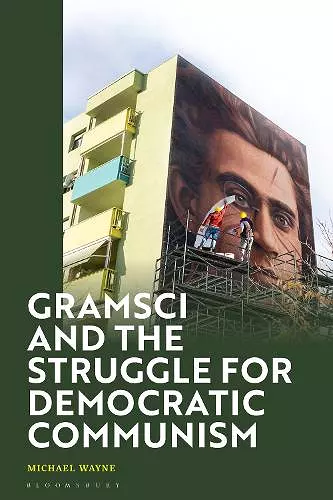
Revitalises the relationship between communism and democracy, using the work of Antonio Gramsci to forge a politics for the Left that is both practical and revolutionary.
With its authoritarian distortions, the Marxism of the 20th century sundered the connections between the practice of Communism, and its essentially democratic ethos.
This book reconstructs those vital threads by turning to the work of Italian Marxist Antonio Gramsci. In the wake of the rise of neoliberalism and the new global order that it ushered in, Gramsci and the Struggle for Democratic Communism asks: what form of political rule can facilitate the transition away from capitalism’s increasingly apocalyptic end game?
To answer this question, Wayne puts Gramsci into dialogue with key thinkers from his own historical period, from Marx, Lenin and Trotsky through to John Dewey and Walter Lippmann. Wayne argues that Gramsci’s contribution to Marxism helps clarify the political inheritance that class democracies bequeath a revolutionary transition. Wayne then puts Gramsci into a critical dialogue with contemporary thinkers such as Stuart Hall, Ernesto Laclau and Antonio Negri, analysing such crisis situations as Britain and Venezuela under neoliberalism. In the final chapter he develops the concept of ‘elongated dual power’ to explore how revolutionary change can be reconciled with democratic principles as the old choice between barbarism or revolutionary change looms once more on the horizon.
Gramsci is famous as the thinker who urged Marxism to come to grips with the question of the political, of institutionality and organisation, of consensus and hegemony. But as this book persuasively demonstrates, the thought of Gramsci also offers a way to rescue and re-imagine democracy in times of acute democratic crisis. Vis-a-vis a declining capitalist democracy which is becoming increasingly illiberal and the embarrassment of a Soviet-style communism which ultimately frustrated working people’s aspirations, Gramsci’s thought invites us to move beyond our present ideological stalemate, and actively work to reconcile social justice and freedom, communism and democracy. This is an essential reading for all those who want to learn more about the relevance of Gramsci for contemporary society and its manifold political dilemmas. * Paulo Gerbaudo, author of Tweets and the Streets (2012), The Mask and the Flag (2017) and The Digital Party (2019). *
In Gramsci and the Struggle for a Democratic Communism, Michael Wayne painstakingly works the intellectual historiography of Marxism and left-revolutionary politics, separating wheat from chaff along the way, in order to recover the democratic impulse at communism’s core. For Wayne, the value of Gramsci’s work comes from the practicality of class struggle; the lessons and resources that worked to realize the ends of the democratic ethos of communism. As Wayne points out we, too, are in a time where democracy and reason are in eclipse. As our contemporary social contradictions deepen and expand, Wayne revivifies Gramsci’s work to re-articulate the slim potential for a political project that halts and redirects our course towards misery, barbarism, and extinction. * Robert F. Carley, Associate Professor of International Affairs at Texas A&M University, College Station *
Gramsci and the Struggle for Democratic Communism is erudite and engaged. Erudition is apparent in Part 1, which reads Gramsci as overcoming the impasse between Kautsky and Lenin; engagement in Part 2, Gramscian readings of Thatcherism and Bolivarianism. The conclusion: 'the odds are not great, but they are not zero * Andrew Milner, Professor Emeritus of English and Comparative Literature at Monash University, USA *
In this historically rich and theoretically challenging book, Michael Wayne relates Gramsci’s reflections on elite and revolutionary hegemony to his era, postwar Britain, and Bolivarian Venezuela. Building revolutionary hegemony to replace bourgeois democracy and capitalism requires wide social alliances, elongated dual power, and extensive participatory and direct democracy. * Bob Jessop, Professor Emeritus, Lancaster University *
In this brilliant book, Mike Wayne provides an exciting new analysis of Gramsci's thought and practice, applying it to the issue which has plagued Marxism since its inception: democracy * Daniel Evans, Lecturer at Swansea University *
ISBN: 9781350447097
Dimensions: 236mm x 154mm x 24mm
Weight: 640g
328 pages