Britain’s Genetic Empire
A Century of Eugenics
Format:Hardback
Publisher:Bloomsbury Publishing PLC
Publishing:18th Feb '27
£85.00
This title is due to be published on 18th February, and will be despatched as soon as possible.
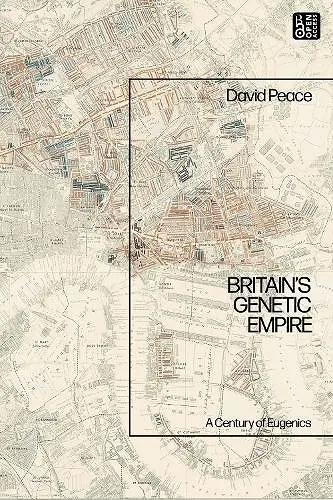
A book that reveals the hidden continuities of eugenic thought in Britain from the late Victorian period to the 1990s.
This open access book uncovers a hidden history of eugenics in Britain, challenging the widely held assumption that these ideas vanished in the wake of the Nazi medical crimes committed in their name during the Second World War. Instead, Britain’s Genetic Empire uses new archival evidence to reveal how the eugenic imagination continued to shape British policies, national identity, and public health into the late 20th century. Moving beyond the familiar histories of the Eugenics Society and Galton Laboratory, David Peace explores how eugenic visions of the future were embedded in the work of economists, doctors, scientists, and policymakers, influencing debates on poverty, ‘racial fitness’, national planning, and population health.
This is the first intellectual history to trace eugenics’ transformation from late-Victorian fears of imperial decline to its post-war manifestations in genetic counselling and the ‘biosocial’ research of the 1980s on racial reproductive differences and population control in international development economics. It shows how hereditarian ideas adapted to new concerns about class, race, and health as Britain’s imperial power waned, finding fresh momentum with the rise of genetics as a scientific field extending beyond its historic disciplinary bounds.
At a time of rapid innovation in genomics and artificial intelligence, and with a resurgence of eugenic beliefs used to justify racism and conspiracy theories, Britain’s Genetic Empire asks what happens when we believe we can predict human futures, and what people are prepared to do when those predictions become reasons to intervene in the lives of others.
The ebook editions of this book are available open access under a CC BY-NC-ND 4.0 licence on Bloomsbury Collections. Open access was funded by the European Research Council (ERC) under the European Union’s Horizon 2020 research and innovation programme as part of the project Taming the European Leviathan (grant agreement No. 854503).
In Britain's Genetic Empire: A Century of Eugenics David Peace offers a rich and original insight into the history and legacy of eugenic thinking, tracing the quiet evolution of eugenic concepts as they were seamlessly integrated into the work of twentieth-century economists, doctors, and policymakers. Built on extensive sources and rigorous methodology, it nevertheless remains a pleasure to read for a broad academic audience. Britain provides a distinctive setting for the history of the eugenic imagination both before and after the Second World War, at a time when eugenics remains a troubling reference point in most parts of the world. Peace's study on history, policies and legacy of eugenics fills not only a significant gap but also stands as a fundamental resource for understanding eugenics across successive social historical periods in the long twentieth century. * Judit Sándor, Professor, Central European University, Vienna *
David Peace has it right: eugenics has always been about imagining the future, then taking action. The fantasies and nightmares of eugenic imaginations have driven some of the most horrific decisions in history. Peace’s scholarship impressively searches behind the curtains of eugenics decision-making in 20th century Britain to uncover the socio-technical imagination of eugenic campaigners, those wannabe heroes of improvement and suppression. For him, eugenics was less about the how and more about the why. He smartly explores how innovations in science supercharged eugenic imaginations and emboldened campaigners to act. The moral of this story is a profound lesson for our time. * Joe Cain, University College London, UK *
ISBN: 9781350587861
Dimensions: unknown
Weight: unknown
312 pages