Ilkhanid Capital Cities
Transcultural Interactions
Format:Hardback
Publisher:Edinburgh University Press
Published:31st Jan '25
Currently unavailable, and unfortunately no date known when it will be back
This hardback is available in another edition too:
- Paperback£24.99(9781399510394)
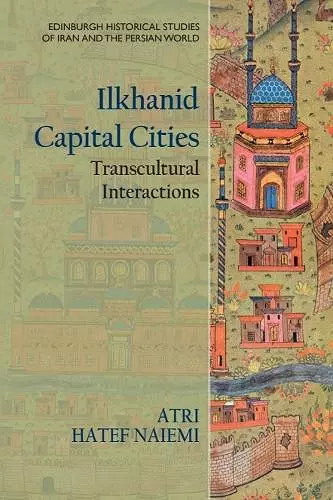
Ilkhanid Capital Cities studies the capital cities founded by the Mongol Ilkhans in Iran during the Ilkhanid period (1256–1335). It primarily focuses on two major cities in the northwest of Iran, Ghazaniyya and Sultaniyya, and examines how the court-sponsored urban projects in these two cities reflected the interactions between Perso-Islamic sedentary concepts and Mongolian nomadic traditions. Questioning the earlier reductive scholarly framework that positioned the Mongols as uncultured barbarians, this study stresses the active role of the Mongol elite not only as agents, but also cultural donors in the Perso-Mongol cultural zeitgeist of late thirteenth- and early fourteenth-century Iran. It provides a fuller and more convincing picture of the Ilkhanid city, which is characterized by a hybrid quality injected not only into the physical structure of the city, but also into the taste, motivations and world views of its patrons.
Hatef Naiemi offers a much-needed, detailed study of the urban interventions and foundations of the Ilkhanids in Iran within the cross-cultural and multi-religious context of the time. Her insightful analysis contextualises these cities within the broader context of the Mongol Empire, from East Asia to Anatolia, and thus is an invaluable contribution to our trans-regional understanding of this period and its architecture. -- Patricia Blessing, Stanford University
This welcome study situates Mongol urbanisation in the political, religious and social history of Iran and surrounding regions. Hatef Naiemi shows how cities developed under the Mongols were sites of acculturation, serving the needs of both the foreign military elite who founded them and the indigenous population that inhabited them. -- Stefan Kamola, Austrian Academy of Sciences
ISBN: 9781399510387
Dimensions: unknown
Weight: unknown
312 pages