The Making of the Arabic Book, Volume 1
How Text Reuse Built a World Tradition
Format:Hardback
Publisher:Edinburgh University Press
Publishing:31st Dec '26
£95.00
This title is due to be published on 31st December, and will be despatched as soon as possible.
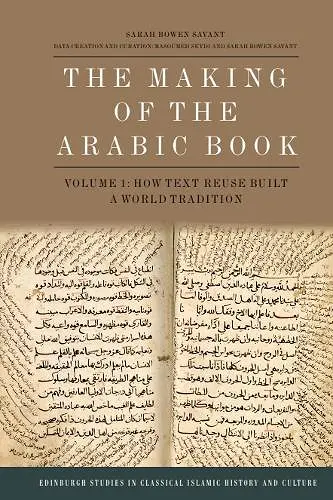
For most historic Arabic authors, creating new works began with reusing existing ones. They reissued, abbreviated, expanded upon, excerpted and otherwise mined their predecessors’ texts as they created fresh new works. In the process, authors produced an enormously intertextual tradition. To reconstruct these relations, the KITAB (Knowledge, Information Technology, and the Arabic Book) project built a digital corpus of thousands of early Arabic books, written over eight centuries from Iberia to Central and South Asia. The team then utilised a text reuse detection algorithm to create an original dataset that documents near-verbatim relationships among all of these books. This volume investigates the broad patterns from the dataset and forensically analyses individual writers’ practices to see how their reuse of earlier works made the Arabic tradition. Using the tools, methods and approaches of the digital humanities, it aims to inspire scholars of all world literatures to investigate the origins and growth of written traditions in novel ways.
A fascinating exploration of medieval Arabic books. Savant's pioneering work brings Arabic studies into the digital age, offering new ways to understand a complex literary tradition. Savant introduces groundbreaking methods to visualize textual transmission and develops a new typology of text reuse, providing fresh insights into one of the world's most bookish cultures. -- Antoine Borrut, University of Maryland
Medieval Arabic societies were among the most bookish in the world. How Text Reuse Built a World Tradition is a milestone in understanding the writerly practices driving this phenomenon and in fully harnessing the potential of computational analysis to think and write about the past. Clearly written, beautifully presented and methodologically innovative, it is a must-read. -- Konrad Hirschler, University of Hamburg
ISBN: 9781399537933
Dimensions: unknown
Weight: unknown
304 pages