The Making of the Arabic Book, Volume 2
Writerly Practices, Memory and Communities
Peter Verkinderen author Gowaart Van Den Bossche author Mathew Barber author Lorenz Nigst author Aslisho Qurboniev author
Format:Hardback
Publisher:Edinburgh University Press
Publishing:31st Dec '26
£100.00
This title is due to be published on 31st December, and will be despatched as soon as possible.
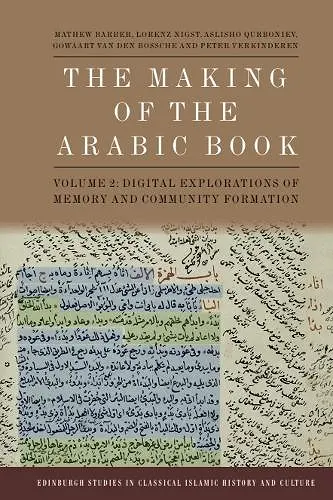
This book is one of two volumes presenting the results of the KITAB (Knowledge, Information Technology, and the Arabic Book) project and their application of text reuse detection to a digital corpus of thousands of Arabic texts spanning eight centuries. The authors begin by examining the function of text reuse in ensuring the survival of books, highlighting the perspectives of individual authors as well as the effect of regional chronological conditions on memories of the past. The second half then goes on to show how memorialisation and recycling of communal texts (such as annals, legal compendia and biographical collections) served to create a shared idea of the past and to sustain a social group’s memories and identity. Using the KITAB project's expansive digital corpus, this book analyses case studies that span North Africa and the Middle East and the Indian Ocean: from the Ismaʿili communities of India, Yemen and northwestern Syria, to Egyptian courts, to Mālikī scholars in North Africa. Altogether, this volume aims to demonstrate the huge potential for digital study of written traditions alongside traditional methods of close reading and manuscript studies, and provide templates for similar studies within Arabic literature and beyond.
The Making of the Arabic Book: Writerly Practices, Memory and Communities is a fascinating exploration of how texts were created, rewritten, and reused as sites of memory. It is a wonderful book showing how digital approaches are opening new horizons for Humanities research. -- Konrad Hirschler, University of Hamburg
To preserve a text was also to shape what later generations could remember. Combining computational analysis with close reading and manuscript evidence, the authors recover the labour behind books and show how that labour sustained communities. A compelling demonstration of how digital scholarship can deepen our understanding of the Arabic written tradition. -- Maxim Romanov, University of Hamburg
ISBN: 9781399537971
Dimensions: unknown
Weight: unknown
368 pages