Sovereign Violences of Racial Terror
Spectacles of Lynching
Format:Hardback
Publisher:Edinburgh University Press
Published:30th Jun '26
Currently unavailable, and unfortunately no date known when it will be back
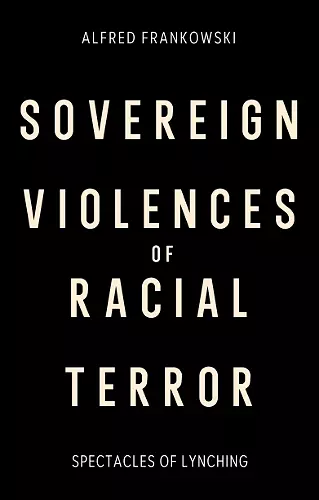
Alfred Frankowski critically examines how the spatiality of lynching violence continues as a politics and functions as an expression of political sovereignty. He argues that terror spectacle lynching and the politics of racial terror are expressions of political sovereignty not only in that this violence was beyond the jurisdiction of law, but also in that it makes sense of the contemporary politics of the racial violence embedded in our sense of space and place. Frankowski concludes that by focusing on lynching, the spatiality of racial terror makes legible forms of global violence, largely through the dispossession of space, mass incarceration, and the degrading of environments, that operate as forms of slow genocide, on the one hand, and the centralizing of political power through the reproduction of spatially terrorized communities, generationally, on the other.
Powerfully disturbing and philosophically transformative, Al Frankowski’s Sovereign Violences of Racial Terror marks the first sustained book-length intervention in academic philosophy to treat lynching not as episodic brutality but as a constitutive form of sovereign anti-Black violence. Refusing to confine racial terror to the past, Frankowski traces its aporias across law, memory, sovereignty, and state power. Moving from the lynching of Emmett Till to contemporary carceral regimes, this work compels a fundamental rethinking of genocide, legitimacy, and the political itself. Urgent, uncompromising, and theoretically rigorous, this book reshapes the terrain of Black political thought and Black philosophy more broadly. -- Tommy J. Curry, The University of Edinburgh and author of The Man-Not: Race, Class, Genre, and the Dilemmas of Black Manhood.
How do we understand the aporia of anti-Black terror, the ontology of that terror itself in its relation to the maintenance of everyday norms, the operation of the state, and to cultural and political memory? In Sovereign Violences of Racial Terror: Spectacles of Lynching, Al Frankowski points to lynching practices as a unique form of this racial terror, needing to be theorized as such in any effort to understand the meaning and ongoing misunderstandings of racism. Perhaps most importantly, in situating lynching within the state’s long historical entanglement with genocide, Frankowski effectively argues that racial terror is not at all extra-judicial but rather integral to the state’s nation-building project. Grounded in a careful study of Mamie Till’s courageous insistence on an open casket, Sovereign Violences of Racial Terror comes at a critical moment of reckoning with the very possibility of multiracial democracies. It is a must-read for understanding what needs to be cleared away - what needs to be asked, and the sense of that interrogation - in order to move beyond what Frankowski names the sheer intolerability of our world. -- Kris F. Sealey, Pennsylvania State University
To read Alfred Frankowski’s text is to be reminded that to truly tarry undeterred with the existential and ontological horror of racial terror lynching is to trouble periodization and its logics of 'clearly delineated' pasts, presents, and futures, along with memorialization and the predictable trajectories of mourning, and the consolation of forgetting. Frankowski’s new and pressing text not only demonstrates the meta-stability of temporality vis-à-vis racial terror but powerfully critiques the logics of spatiality where it is assumed that here and there are the exhaustive definitive geographical limits and markers of the sites of racial terror. Such an approach — to historically fetishize the identity of time and place — only obfuscates, conceals, and renders unintelligible the normativity of racial terror and its anti-Black sensibilities that subtend the spectacularity of specific events in/across time and in/across space generationally. This is what makes Frankowski’s text so demanding as our fight isn’t against a specific act of terror and, as he says, there is no clear end in view. Silence, though, is no option as Frankowski proposes dissent (to feel/to think) against the necro-political, racial state/state terrorism that not only haunts the world but constitutes the world. He proposes nothing short of the aesthetic redistribution of meaning which marshals structures of sensibility and thinking that open up questions regarding the conditions of livability. -- George Yancy, Emory University
ISBN: 9781399559430
Dimensions: unknown
Weight: unknown
168 pages