Violence in Medieval Europe
Format:Paperback
Publisher:Taylor & Francis Ltd
Published:17th Aug '10
Should be back in stock very soon
This paperback is available in another edition too:
- Hardback£210.00(9781138425408)
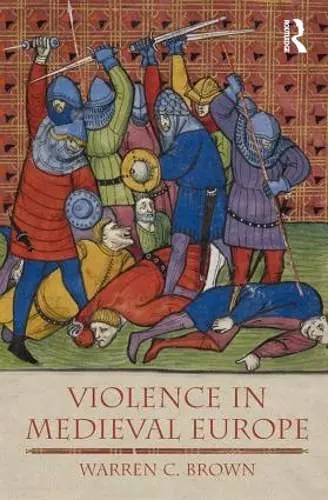
The European Middle Ages have long enjoyed a reputation as a very violent period. Violence was part of everyday life and of church and state. This new textbook helps students to connect imagination to history by synthesizing recent scholarship and current debates on the topic, and enabling them to understand to what degree violence characterized medieval Europe.
Drawing on a wide variety of primary sources, Warren Brown examines the norms governing violence within medieval societies from the sixth to the fourteenth century, over an area covering the Romance and the Germanic speaking regions of the continent as well as England.
Medieval Violence is generally cast by modern popular media in two contradictory ways: either as a reflection of medieval brutality and lawlessness or as the basis for a romantic life of freedom, glory and honour. This book will introduce students to the questions and evidence that are driving current debates about whether and to what degree violence characterized medieval Europe.
· This is the first book to draw together a diverse scholarship into a narrative about violence across the entire Middle Ages.
· Warren Brown includes many real life examples to capture the imagination of the student and the interested reader
· Provides a synthesis of recent and classic scholarship about medieval violence, conflict, and power in all of the relevant languages and is based on primary sources that are readily available in English translation
The author focuses on violence used by individuals or small groups within a given society as a tool for achieving personal or political ends and/or for expressing emotion.
The question of violence understood in this way dominates current efforts to understand power and political order in medieval societies. For example, it occupies centre stage in debates over the co-called 'feudal revolution' of the first millennium and over the development of national states in the later Middle Ages. These discussions hinge on the following questions: did violence subvert political order or help to uphold and maintain it? How did the relationship between violence and political order change over time? What did 'peace' mean and what did violence have to do with it? Scholars have often told the story of violence and power in the Middle Ages as one in which 'private' violence threatened and sometimes destroyed 'public' order. Yet some academics are asking to what degree violence that we might call 'private', in contrast to the violence wielded by a central authority, might have been part of a viable alternative or complementary order, or at least might have been understood and legitimised in this way by its practitioners. Following this line of...
"One of the particular merits of this study as a textbook is its demonstration of how to approach the primary sources. The case-studies emphasise how important the perspective of the sources is in determining whether actions are reported as legitimate or illegitimate violence. Each chapter opens with a sure-handed sketch of the wider context, with an impressive summary of the ‘Transformation of the year 1000’ in Chapter Four, for example, and an excellent introduction to the study of ritual in Chapter Five.
Brown succeeds both in showing that medieval violence was purposeful and embedded in changing norms, and in offering some new perspectives on the sources and topics covered. This is a clear and stimulating survey, which will be a valuable addition to reading lists, and provoke further discussion among specialists."
- The English Historical Review
ISBN: 9781405811644
Dimensions: 100mm x 100mm x 100mm
Weight: 100g
344 pages