Race, Real Estate and Education
Inventing Gentrification in Philadelphia, 1960-2020
Format:Paperback
Publisher:Temple University Press,U.S.
Published:12th Sep '25
Should be back in stock very soon
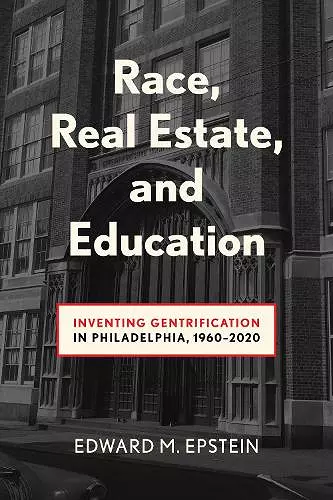
Philadelphia’s urban renewal efforts in the 1950s, which re-envisioned the city as a residential enclave, were an early example of gentrification. In West Philadelphia in the 1960s, a coalition of universities and hospitals went further, initiating K-12 public school improvements meant to attract an affluent and whiter population. As Edward Epstein details in Race, Real Estate, and Education, these interventions discounted the negative impact they could have on neighborhood residents.
Epstein outlines the citywide context for the plan to create “University City” in West Philadelphia. He recounts the attempts to correct the segregation, overcrowding, and authoritarian management that plagued Philadelphia’s public schools. As the West Philadelphia Corporation, the proxy for the universities and hospitals, initiated gentrification efforts, the local community resisted and protested, causing the project to fail. The effort was revived with spectacular success, however, with the launch of the well-funded Penn Alexander School in 2001.
Race, Real Estate, and Education shows how the pursuit of urbanist ideals sometimes deepens neighborhood injustice. Epstein’s exploration of whether Philadelphia’s overall approach was beneficial or misguided presents a cautionary tale.
In the series Urban Life, Landscape, and Policy
“Epstein presents a nuanced, textured history that is enriched by personal accounts, informative maps, and wonderful, vivid illustrations. In clear prose and with thorough documentation, he fleshes out the many ways that good intentions, naivete, and idealism have combined with greed, concentrated power, and racism to shape West Philadelphia.”—Hidden City
“Epstein provides a careful, well-documented delineation of the synchrony between local public education improvement efforts in West Philadelphia and attempts to stabilize (reputationally and financially) the neighborhood’s major institution of higher education. He shows how the initiatives, while effective in some ways, also reproduced privilege and provided less help than they might have to historically disadvantaged K–12 students. Race, Real Estate, and Education is novel in centering education policy as an element of ‘revitalization’ near Penn’s campus.” — Laura Wolf-Powers, Professor of Urban Policy and Planning at the City University of New York–Hunter College, and author of University City: History, Race, and Community in the Era of the Innovation District
“By showing how universities have used K–12 education as a tool to shape their urban environs, Race, Real Estate, and Education adds an important dimension to the literature on university-driven gentrification and, more broadly, on present-day urban transformations. Epstein takes a deep dive into the history and context of the University of Pennsylvania’s participation in post-war urban renewal efforts that set the stage for a decades-long, agonizingly slow, and fitful process that eventually succeeded in transforming West Philadelphia from a kind of ‘urban village’ to an ‘innovation district,’ as the planners originally intended. Epstein brings richness to the story through interviews with displaced residents and former students that illuminate the experience of loss and change and being in the crosshairs of contention about race and community futures.” — Elaine Simon, former Codirector of the Urban Studies Program at the University of Pennsylvania, and coauthor of Schools for Sale: Disinvestment, Dispossession, and School Reuse in Philadelphia
ISBN: 9781439926321
Dimensions: unknown
Weight: 454g
218 pages