British Fascist Antisemitism and Jewish Responses, 1932-40
Examining antisemitism and Jewish opposition in interwar Britain
Format:Paperback
Publisher:Bloomsbury Publishing PLC
Published:19th May '16
Currently unavailable, and unfortunately no date known when it will be back
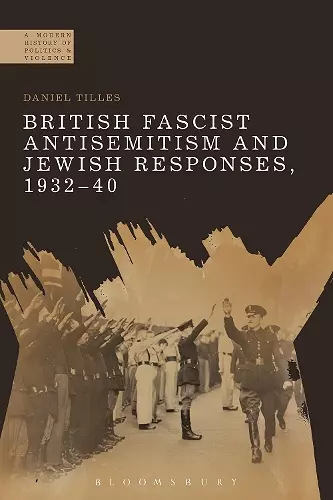
This insightful examination reveals the antisemitism of the BUF and the proactive responses of Britain's Jewish community during 1932-40.
This book delves into the complex interplay between antisemitism and the Jewish community in Britain during the interwar period, particularly focusing on the British Union of Fascists (BUF) and its leader, Sir Oswald Mosley. British Fascist Antisemitism and Jewish Responses, 1932-40 examines how the BUF's antisemitic ideology was not only a significant aspect of its political agenda but also a reflection of broader European fascist movements. Daniel Tilles presents a fresh perspective, arguing that the antisemitism espoused by the BUF was integral to its identity rather than a mere opportunistic tactic, as previously suggested by scholars. This reevaluation sheds light on the motivations behind Mosley’s fascism and the ideological underpinnings that shaped the BUF's policies toward Jews.
The author also highlights the responses of Britain's Jewish community to the rising tide of fascism, emphasizing their proactive stance against antisemitism. While traditional narratives often depict Jews solely as victims, Tilles illustrates how they actively influenced the trajectory of British fascism through organized anti-fascist activities. The book provides a dual perspective, analyzing both the fascists' antisemitic rhetoric and the dynamic responses from Jewish groups, ultimately contributing to a more nuanced understanding of this historical period.
British Fascist Antisemitism and Jewish Responses, 1932-40 offers valuable insights into the historical context of interwar Britain, positioning the Jewish community not just as passive observers but as key players in the fight against fascism. This work is an essential read for anyone interested in the intersections of politics, society, and identity during a tumultuous era.
Self-assured and clearly in command of his material, Tilles offers a compelling account of the development of both the BUF’s antisemitism and the variegated response to it by Anglo-Jewry ... The author achieves something rather splendid: he really does breathe new life into this ‘exhausted’ subject ... This is a tightly defined, in-depth, cogent and assertive study. Without doubt, it re-energizes the field. -- Nigel Copsey, Professor of Modern History, Teesside University, UK * Patterns of Prejudice *
Tilles has taken our breath away with a thoroughly researched investigation that challenges much received wisdom concerning this most sensitive subject. Using new material as well as reinterpreting well-thumbed existing accounts, he offers us a provocative but at the same time compelling re-telling of the narrative. * Geoffrey Alderman, University of Buckingham, UK *
Daniel Tilles has produced the most detailed and nuanced account of the British Union of Fascists’ antisemitism and Jewish responses to it. Utilising new sources and re-assessing old ones, he provides a thought-provoking analysis of the nature of BUF antisemitism, including that of its leader, Oswald Mosley. Tilles also shows the complex and, he argues, successful Jewish actions against the vile attacks of Britain’s largest fascist movement during the 1930s. * Tony Kushner, Director of the Parkes Institute, University of Southampton, UK *
This book brings a breath of fresh air to the study of the British Union of Fascists and of Jewish responses to the threat it posed. In clear, forceful prose, Daniel Tilles demolishes two long-standing interpretations: that the BUF embraced antisemitism belatedly and only after Jews disrupted their meetings, and that the response of the Jewish communal elite was timid by comparison with the militant response of Jewish workers and Communists. His argument, which draws in large part on hitherto unavailable archival materials, is compelling and has far reaching implications. * Todd Endelman, Professor Emeritus of History and Judaic Studies, University of Michigan, USA *
Painstakingly-researched addition to this field. -- David Renton, Garden Court Chambers, London * Cercles *
ISBN: 9781474286428
Dimensions: 232mm x 154mm x 18mm
Weight: 420g
272 pages