Orthodoxy on the Line
Russian Orthodox Christians and Labor Migration in the Progressive Era
Format:Hardback
Publisher:New York University Press
Published:22nd Jul '25
Should be back in stock very soon
Working-class immigration, religion, and labor history in the United States
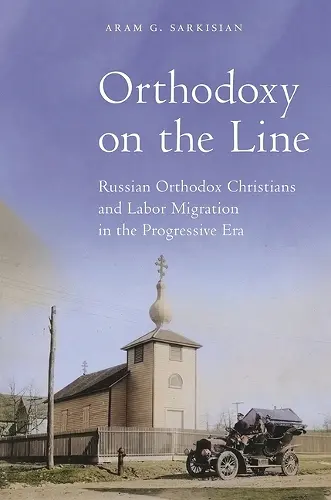
At the turn of the twentieth century, thousands of immigrants from the borderlands of the Russian and Austro-Hungarian Empires built a transnational church in North America. The community that church leaders called American Orthodox Rus' was created by and for working people, and transformed believers' identities as Eastern European migrants, as Orthodox Christians, and as American workers.
Given how strongly the Russian Orthodox Christian community was tied to working class industrial life, this book makes the case that we cannot understand the scope of working class and immigrant religion in the United States without understanding American Orthodox Rus'. The work Russian Orthodox immigrants did in the Progressive Era United States occurred in factories, foundries, and mines; they lived mainly in industrial cities and mining towns; and they almost immediately got caught up in the most pivotal—and sometimes violent—political and social crises of their times, both nationally and internationally. To address their needs in these contexts, the Russian Orthodox Church expanded its missionary efforts in North America, forming a network of social and material aid for working-class believers. This book traces the rapid growth of this transnational religious world, then explores its unexpected collapse under the weight of the First World War, a global pandemic, and the transnational reach of revolutionary political change in Russia. A story of challenge and resilience, Orthodoxy on the Line complicates dominant paradigms in the study of labor and North American Religions.
"Offers a beautifully rendered account of an immigrant church too often left out of the stories told about religion in the United States. Transnational in scope and yet grounded in distinct working-class communities, Sarkisian's history of Russian Orthodox Christianity in North America richly evokes the metropolitan streetscapes, mining towns, parish conflicts, and devotional rhythms that shaped immigrant experience. This is a superbly wrought study of lived religion—one that simultaneously captures the socioeconomic vulnerabilities of local enclaves and the global politics of industrial capitalism, war, and revolution. A striking achievement!" - Leigh Eric Schmidt, Edward C. Mallinckrodt Distinguished University Professor in the Humanities, Washington University in St. Louis "Tells the largely unknown history of working-class immigrants who lived between two worlds: America and the empires they left behind. Capturing the smells and tastes of everyday life as well as fierce theological fights, Sarkisian shows how miners and factory workers and clerical families trying to live their faith experienced labor riots, the Great War, the Russian Revolutions, the Spanish flu, and the Red Scare. . . . Everyone interested in working-class American religion, trans-national Orthodox diaspora communities interacting with momentous changes in the old country, ethnicity, and immigration must read it." - Nadieszda Kizenko, author of Good for the Souls: A History of Confession in the Russian Empire. "Aram Sarkisian opens his marvelous new book with the story of a little boy slipping past the icon screen of his Russian Orthodox Church on a winter Sunday in 1917. In the pages that follow Sarkisian takes us past the screen too, where he reveals in vivid detail and elegant prose the forces that coursed through the most sacred spaces of the early twentieth century American 'Rus, as the faithful tried to make a place for themselves in a world of shuddering change." - Kevin Boyle, author of Arc of Justice: A Saga of Race, Civil Rights and Murder in the Jazz Age
ISBN: 9781479833153
Dimensions: unknown
Weight: 635g
336 pages