Violence and Justice in Bologna
1250–1700
Format:Hardback
Publisher:Bloomsbury Publishing PLC
Published:2nd Apr '18
Currently unavailable, and unfortunately no date known when it will be back
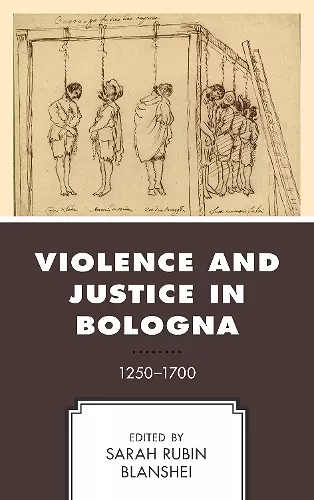
This collection of essays offers a unique contribution to the study of violence and justice in a late medieval and early modern Italy by combining a multivocal perspective with a case-study focus on the city-state of Bologna. Drawing on the city’s singularly rich archival resources, the authors explore various facets of violence—ranging from the interpersonal to the less frequently studied typologies of blasphemy, rape, political rebellion, and student brawls—and set the institutions of the police and law courts into their socio-political and cultural contexts. They also apply a broad variety of quantitative and qualitative approaches—processual, microhistorical, legalism, comparative and criminological—to their assessments of the procedures and practices of criminal justice and the experiences of violent behavior, providing both short-term, in-depth analyses of specific events and over-arching reviews of long-term trends.
Bologna itself, with its renowned university, economic innovations, strategic importance as a commercial and cultural crossroads, its political volatility and experiments with diverse constitutional structures, provides a rewarding laboratory for analyzing changes and continuities in late medieval and early modern violence and justice. From these studies emerges a narrative that challenges the traditional portrayal of those periods as eras when brutality and rage were “normal” in social relations and criminal justice was characterized mainly by punitive strategies of torture and repression.
Violence and Justice in Bologna, 1250-1700 makes significant contributions to both the history of violence and the history of state formation, refuting or revising influential arguments. Excellent volume ---- the nonlinear development of violence and justice in Bologna is revealed and set in context. * Journal of Modern History *
This volume, edited by the reigning magistra of its theme, combines innovative approaches to key issues in the specialist literature with new sources to produce a noteworthy addition to the flourishing scholarship on institutions of conflict management and peace-making in the medieval Italian cities. Blanshei’s lucid editorship lends a rare unity of tone to the volume. . . contributions, the fruit of a diverse range of junior and established scholars, exemplify the value of cross-periodization collaboration, the continuing vitality of research grounded in Italy’s archival riches, and the central role that medieval court records play in understanding state formation's unfolding in real time. This will be essential reading for experts and graduate students for some time to come. . . . The exceptionally cogent and comprehensive overview, in the introduction, of historiography on justice and violence in the medieval Italian communes, the variety of topics and approaches on offer, and the affordable price, make Violence and Justice in Bologna appropriate for graduate seminars, in addition to being highly recommended for scholars interested in the relationship between institutions, norms, and social responses to these over time. * H-Net: Humanities and Social Science Reviews Online *
Delineating the preexisting social relations and the complex political and judicial contexts for the eruption of different types of interpersonal violence and the efforts to punish them, the volume
constitutes a significant contribution to the historiography of medieval and Renaissance Italy.
The ten studies included in this volume offer fresh perspectives on criminal justice in late medieval and early modern Bologna. Drawing on the data preserved in the city’s exceptionally rich judicial archives, these informative and accessible studies reveal that neither the ebb and flow of violence and crime nor intricate judicial procedures and practices can be understood apart from Bologna’s shifting political contexts. The volume, meticulously edited by Sarah Rubin Blanshei, who places each study within a larger comparative framework, makes an indispensable contribution to late medieval and early modern history. -- Julius Kirshner, University of Chicago
This important collection of essays explores critical questions about criminal justice and the nature of violence in late medieval and early modern Bologna. Sarah Rubin Blanshei harmonizes the perspectives of leading scholars in the field as well as the voices of new scholars to offer a wide variety of approaches and methodologies. The result is a fascinating view of continuity and change in violence and criminal justice in Bologna over a period of nearly five hundred years. -- Joanna Carraway Vitiello, Rockhurst University
Were the ‘better angels of our nature’ hard at work civilizing Europeans in the centuries from the Renaissance to the Enlightenment? Was violence falling and justice rising? These essays dig into the extraordinary wealth of Bologna’s criminal archives to shed light on some of the most hotly disputed questions around crime and justice in the critical early modern period. Victims’ voices, defendants’ pleas, magistrates’ opinions, and authorities’ strategies all weave together in a series of studies that demonstrate the many forms of violence that rocked Italian society, and the many judicial institutions that evolved to clean up or at least mediate the damage. Who murdered, stole, blasphemed, or fought and why? How did magistrates and judges do their work? These authors also tackle the big debates: Are expanding judicial systems a centralizing tool for an expanding state, or improvised vehicles for negotiating individual conflicts? Must we—or even can we—decide? -- Nicholas Terpstra, University of Toronto
Bologna, one of few cities that offer such a varied range of governments and the extensive survival of criminal records throughout this period, serves as the laboratory for a balanced mix of established and junior scholars to dissect the workings of a wide range of courts. This volume offers a phenomenal introduction to the different approaches to studying criminal justice and the debates within it, offering a much-needed reminder of how integrated justice and politics can be. The authors challenge widely held assumptions about vendetta, rape accusations, student violence, and much more, as they problematize any attempt to show linear or smooth developments in criminal justice across the period. The essays’ differing foci on enforcement, investigations, and trials provide an extensive view of the judicial processes and personnel, but also address why potential litigants chose specific judicial mechanisms or abandoned them. The mix of engaging case studies and quantitative analyses reinforces just how much the status of offenders and victims and the political climate influenced legal rights, enforcement, and sentencing. -- Glenn Kumhera, Penn State Behrend
ISBN: 9781498546331
Dimensions: 239mm x 158mm x 27mm
Weight: 608g
300 pages