The Battle of Hengyang
Japan's Fateful Siege in World War II
Format:Hardback
Publisher:Westholme Publishing, U.S.
Publishing:13th Aug '26
£28.00
This title is due to be published on 13th August, and will be despatched as soon as possible.
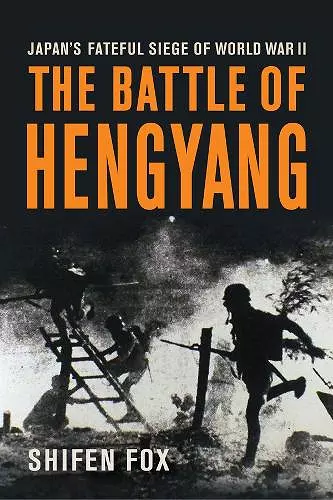
The first English language history of China's Most Important Battle in World War II
In April 1944, Imperial Japan launched Operation Ichigo to secure a transport route linking Japanese forces in northern China and Southeast Asia, while eliminating American airfields in the region. The Japanese army quickly overran Chinese resistance and pushed fast toward the city of Hengyang, a key railway junction in south-central China. The Battle of Hengyang began on June 23, 1944. With just 17,000 troops and besieged in an area of less than ten square miles, the Chinese 10th Army held off a Japanese force totaling more than 110,000 men, supported by aircraft, tanks, chemical weapons, and artillery, for forty-seven days. The fighting was among the most savage of the entire Second World War. Hengyang finally fell on August 8, but the Chinese defenders and undaunted American pilots had stopped Ichigo’s momentum. The Japanese military’s failure to quickly conquer such a small city led to the fall of Japanese Prime Minister Tojo’s cabinet in July 1944, ultimately weakening Japan’s resolve to prosecute the war. News accounts compared the battle to the German defeat at Stalingrad in its ferocity and to the Battle of Suiyang, the most famous siege in ancient Chinese history.
In the aftermath of World War II, the battle was erased from Chinese history books since Communist propaganda insisted that only they, not the Nationalists, had successfully resisted the Japanese. But the survivors, both soldiers and civilians, kept the battle alive in their memories, and during the early part of the twenty-first century, the truth of Hengyang was finally presented to the Chinese people. The Battle of Hengyang: Japan’s Fateful Siege of World War II by Shifen Fox is the first English language history of one of the most important battles of the Second World War. The author returned to China where she interviewed survivors and children of survivors, read private letters, and had access to normally closed archives; in addition, she read memoirs written by Japanese survivors and referenced Japanese historical records. Learning late in life that her father perished in the battle, she also explains how the role of her father and this heroic defense was censored by China, but more than eighty years later has now been restored to its place in Chinese and world history.
“In this deeply researched and vividly narrated work, Shifen Fox restores the siege of 1944 to its rightful place—as a testament to the endurance of Nationalist forces under impossible conditions. Drawing on Chinese sources, military analysis and personal accounts, including that of her own father, this book illuminates not only a brutal battle, but a nation’s struggle for survival at a moment when its fate hung in the balance.”—Scott D. Seligman, author of Murder in Manchuria: The True Story of a Jewish Virtuoso, Russian Fascists, a French Diplomat, and a Japanese Spy in Occupied China
“Although virtually unknown in the West, the five-week-long Chinese defense of Hengyang, Hunan, in the summer of 1944 reveals the often-unrecognized tenacity and fierceness of Chinese resistance to the Japanese invasion of their country that had begun in 1937. Beyond making this point, though, readers of this book will appreciate the author’s ability look beyond military maneuvers to narrate the experiences of the participants in this conflict from top leaders down to common soldiers.”—Edward A. McCord, George Washington University
ISBN: 9781594164613
Dimensions: 229mm x 152mm x 33mm
Weight: 708g
320 pages