Stael’s Philosophy of the Passions
Sensibility, Society and the Sister Arts
Tili Boon Cuillé author Karyna Szmurlo author
Format:Paperback
Publisher:Associated University Presses
Published:29th Sep '14
Currently unavailable, and unfortunately no date known when it will be back
This paperback is available in another edition too:
- Hardback£102.00(9781611484724)
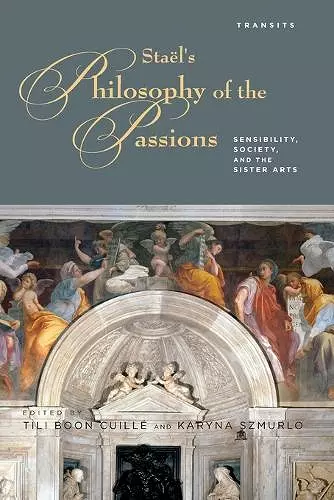
Sensibility, or the capacity to feel, played a vital role in philosophical reflection about the natural sciences, the social sciences, and the arts in eighteenth-century France. Yet scholars have privileged the Marquis de Sade’s vindication of physiological sensibility as the logical conclusion of Enlightenment over Germaine de Staël’s exploration of moral sensibility’s potential for reform and renewal that paved the way for Romanticism. This volume of essays showcases Staël’s contribution to the “affective revolution” in Europe, investigating the personal and political circumstances that informed her theory of the passions and the social and aesthetic innovations to which it gave rise. Contributors move seamlessly between her political, philosophical, and fictional works, attentive to the relationship between emotion and cognition and aware of the coherence of her thought on an individual, national, and international scale. They first examine the significance Staël attributed to pity, happiness, melancholy, and enthusiasm in The Influence of the Passions as she witnessed revolutionary strife and envisioned the new republic. They then explore her development of a cosmopolitan aesthetic, in such works as On Literature, Corinne, or Italy, On Germany, and The Spirit of Translation, that transcended traditional generic, national, and linguistic boundaries. Finally, they turn to her contributions to the visual and musical arts as she deftly negotiated the transition from a Neoclassical to a Romantic aesthetic. Staël’s Philosophy of the Passions concludes that, rather than founding a republic based on the rights of man, Staël’s reflection fostered international communities of women (artists, models, and collectors; authors, performers, and spectators), enabling them to participate in the re-articulation of sociocultural values in the wake of the French Revolution.
Contributors: Tili Boon Cuillé, Catherine Dubeau, Nanette Le Coat, Christine Dunn Henderson, Karen de Bruin, M. Ione Crummy, Jennifer Law-Sullivan, Lauren Fortner Ravalico, C. C. Wharram, Kari Lokke, Susan Tenenbaum, Mary D. Sheriff, Heather Belnap Jensen, Fabienne Moore, Julia Effertz
This volume, edited by Cuillé and Szmurlo, positions Madame Germaine de Staël at the crossroads of emotion and cognition, bridging the Enlightenment's intellectual heritage and Romanticism's passions. Staël lays the groundwork for much of 19th-century literature and opens many fruitful avenues of inquiry, ranging from anthropology and psychology, the philosophical and the political, to nationhood and gender. North American scholars from fields within and beyond the academy contribute chapters that seem particularly coherent, given the remarkable breadth of Staël's thought and works. The sections entitled "The Politics of the Passions," "International Aesthetics," and "Philosophy and the Arts" represent ensembles that fit well together. While each contributor's work is strong, of particular note are chapters by Karen de Bruin on the use of melancholy as seen through the character of Corrinne and the superiority that she represents, and Heather Belnap Jensen's study of Staël's depiction of women art collectors in Napoleonic Europe. For its ability to offer entry into Staël's work from a variety of perspectives and disciplines, this is an extremely valuable resource for understanding the evolution of intellectual thought at the beginning of the 19th century. Summing Up: Highly recommended. Undergraduates through faculty, general readers. * Choice Reviews *
This impressive and useful study examines Germaine de Staël’s views on the passions, “the language of the heart,” and their revolutionary impact. . . On the whole, the chapters offer engaging and intelligent studies, as well as strong argumentation and documentation. The collection includes a valuable bibliography. . . . this collection highlights Staël’s role in the “affective revolution” aimed at the betterment of individuals and society. Through its interdisciplinary nature, the work exemplifies the themes of exchange so dear to Staël in her quest for reform. * Nineteenth-Century French Studies *
Tili Boon Cuille´’s Introduction situates Stae¨l in relation to Enlightenment thinkers and their treatments of sensibility as it pertains to politics, art, and relations between the two. ... The two editors have made crucially important contributions to the advancement of Stae¨l studies, and their generous encouragement of young scholars, who are well represented here, is exemplary. * French Studies *
ISBN: 9781611486360
Dimensions: 224mm x 156mm x 25mm
Weight: 522g
346 pages